Pages

Friday, February 23, 2018

February 22, 2018 – Stewart Island, New Zealand

Our ship’s daily newspaper, titled Reflections, had a lead story today on Stewart Island subtitled “The Ends of the Earth” and, in a way, that’s true. Stewart Island (also known as Rakiura) is the third-largest island of New Zealand and lies 18 miles south of the much larger South Island, across the Foveaux Strait. We are now at 47° South latitude. As a point of reference in the northern hemisphere, Ottawa and Minneapolis are both at 45° N, and Bismarck, North Dakota is at 47°N. One difference from these three cities is that there isn’t any major land mass between Stewart Island and the South Pole (Antarctica).

Stewart Island is about the size of the city-state of Singapore, with a total population of slightly less than 400. Of that number, 322 live in the largest settlement of Oban, where we will be visiting today. The Symphony anchored off shore, and we came ashore via tender boats.


Based on all this, we ventured onto this island with low expectations. Boy, were we wrong! We greatly enjoyed our visit here and were surprised to learn that it is a popular destination for people interested in the outdoors – walking, hiking (backpacking), and fishing. Eighty-five percent of the land on the island is a national park, and other land is set aside for public or conservational use. Only about 3% of the land is available for housing or business use.

We signed up for a shore excursion on Stewart Island (sort of a “panoramic tour”) on a small, 20-person minibus and were very fortunate to have a fairly young Australian girl named Erin (probably in her 20’s) as a driver/guide. She had visited here, fallen in love with the pure natural environment, and moved to the island two years ago. She just bubbled with enthusiasm.


She told us there are only three primary roads in town. We covered them quickly and then headed out of town. An interesting statistic – there are only 17 miles of roads on the island, but there are 215 miles of what are called “walking tracks” on Stewart Island for hiking and backpacking. We saw backpackers of all ages everywhere we went on the island.


Here are some fun facts we learned from Erin:
- Almost everything in the way of food or other staples travel here on a freight boat, Visitors arrive either by fast ferry from the “mainland” (South Island) or via a small air strip used to deliver visitors (6 – 12 at a time) on very small airplanes. Emergency medical airlift is by these same planes or by helicopter.

- There are 30 students in a primary school, but no high school. HS students go to a boarding school on the “mainland” (South Island) Monday - Friday and travel back and forth by ferry.

- Water source for all homes is rain water. All have tanks to accumulate water.

- There is no crime and only one police officer.

- There is only one sports field and only one competitive game (rugby) is played per year, and it is a major community event.

- There are many kiwi birds on the island, but they only come out at night. We read (in another source) that there are more kiwis on the island than humans -- we didn’t see any of them today.

- Most original settlers were Scottish. There are two churches on the island – one Anglican, and one Presbyterian.

- During the summer season, the population doubles with tourists and (tourist-related) additional workers. The number of tourists is limited by the places they can stay (only one small hotel and a few rental cottages). Most tourists are “day-trippers” or backpackers who live in huts on the walking tracks.

For our visit, the weather was mostly sunny and pleasant, with a few periods of very light (misty) rain. Foliage was a very pretty green color. There are a few golden sand beaches, but the water is really too cold to swim in without wearing wetsuits. When the wind comes from out of the south, it can get chilly here; but Erin said that it never snows.


After the short, 90-minute tour, we had a good time walking around this apparently healthy, happy, conservation-minded community.

Jim & Ginny

Wednesday, February 21, 2018

February 21, 2018 – Fiordland, New Zealand

Cruising from Sydney the past two days, the Tasman Sea lived up to its advance billing as an area of strong winds and rough seas. The ship has been rocking and bobbing a lot, and it’s been difficult just to walk down the hallways. Jim checked the weather on our stateroom TV a couple of times yesterday (for just a moment each time). One time the wind was 51 knots and the second time it was 60 knots (59 mph and 69 mph respectively). We don’t know what the speed was the remainder of the day, but it was definitely windy and seas were choppy!

When we awakened early this morning for our full-day cruise through Fiordland, it was cloudy and gloomy, but not rainy – hooray!

At 7:00 a.m., the ship slowed down to pick up two pilots to guide the ship through the fjords today, along with an interpretive guide who give us a running verbal description of what we were seeing, over the ship’s loudspeaker system.

The area known as Fiordland is a remote wilderness region in the southwestern corner of the South Island of New Zealand. This part of South Island is dominated by snow-capped mountains called the Southern Alps, with glacier-carved and now ocean-flooded western valleys. New Zealand’s Fiordland National Park covers 3.1 million acres – nearly 5% of the nation’s total land mass – and was declared a World Heritage Area in 1986.

The name "Fiordland" obviously comes from a variant spelling of the Scandinavian word "fjord,” but we don’t know why it’s spelled differently. The original English settlers also mistakenly called the fjords to be “sounds.” They are definitely fjords, which are commonly defined as long, nar­row inlets with steep sides or cliffs, created by a glacier. We don’t know why New Zealand still calls them “sounds.” Tradition lives on.

Way back in history, glaciers covered this area, gouging and deepening U-shaped valleys through the mountains, until they eventually reached the sea. Sea water then filled into the valleys, forming fjords. Fiordland National Park contains 14 spectacular fjords along 125 miles of rugged mountainous terrain and coastline.

Our guide told us that weather here (between 44° and 46° South latitude) is dominated by frequent westerly wind flows. When moisture-laden air from the Tasman Sea reaches the mountains, it is forced to rise over the barrier of mountains. It then cools quickly and creates heavy rain and snow. Within the park, annual rainfall varies from 47 inches (in Te Anau) to 315 inches (in Milford Sound). He said that rain falls in Fiordland, on average, over 200 days each year. At Milford Sound, it rains 300 days per year. We got lucky today!

Much of the terrain in Fiordland is classified as temperate rain forest. Evergreen trees and shrubs cling to steep faces of hard rock covered only by a thin layer of peat – humus and moss.

Interestingly, within the fjords the heavy rainfall creates a permanent freshwater layer (about 130 feet deep) above the sea water. We were told that the freshwater layer appears to be black in color because tannin leachs into the fresh water as it flows downhill through vegetation on its way down to the fjord.

Captain James Cook and his crew were the first Europeans to set eyes on this dramatic part of the world in 1770 and 1773. During his 1773 voyage, he established a tiny settlement and spent five weeks in Dusky Sound. Cook mapped the area and named all the fjords. His names are still in use today.

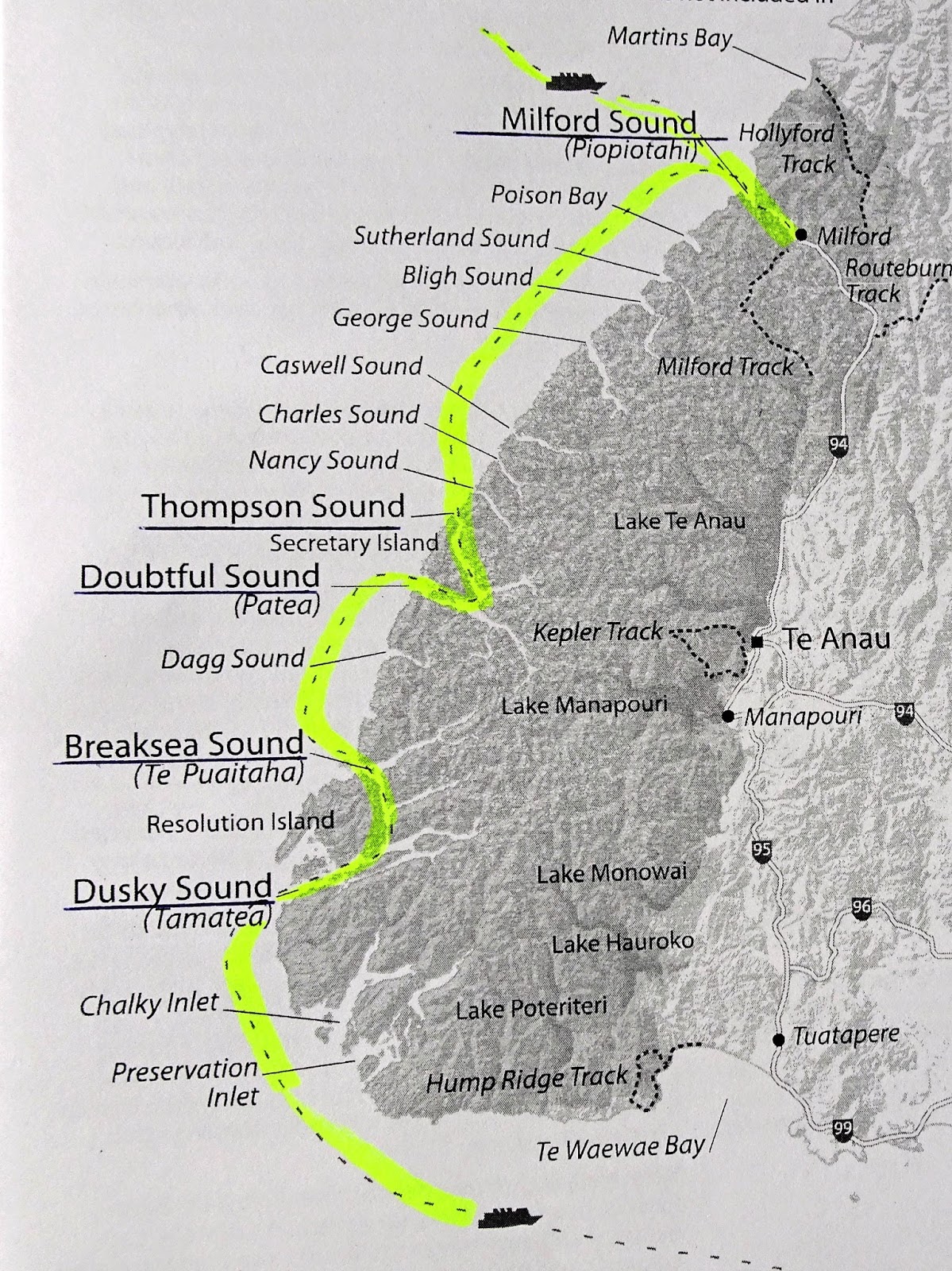
Here is the route on which the local pilots led us today, visiting five of the “sounds” from north to south.


Crystal Symphony entered Milford Sound soon after 7:00 a.m. Milford runs inland from the Tasman Sea for about nine miles in length – the shortest of the “sounds.” It is narrow where we entered (600 yards wide) and then opens to about one mile in width at its widest point. Our destination lecturer told us that there are many walking trails within the park, and one of them at Milford Sound takes about four days to complete. He claims, however, that the scenery views are very rewarding. We were told depth of the water is about 1,000 feet.

Highlights of our cruise through Milford Sound include steep cliffs on both sides of the fjord and, of course, several waterfalls cascading hundreds of feet into the deep black fjord. Milford Sound has two permanent waterfalls ─ Lady Bowen Falls and Stirling Falls. Naturally, after heavy rain, temporary waterfalls run down the steep-sided rock faces that line the fiord. Nearby Mitre Peak is nearly one mile in elevation.


Following along on the map, after turning around and returning to the Tasman Sea from Milford Sound, we followed the mountainous coastline offshore on our port (left) side down to Thompson Sound. We turned into Thompson Sound at about 1:00 p.m. and cruised through a small passage into the much longer Doubtful Sound (about 25 miles in length). Doubtful is also the deepest of the fjords (about 1,400 feet deep). Our guide told us that this fjord is rich in animal life, including Bottlenose Dolphins, New Zealand Fur Seals, and Fiordland Crested Penguins, although we didn’t see any of them. Doubtful is apparently known for “The Sound of Silence.” There are no roads leading to Doubtful Sound as there are to Milford, so it’s isolated and there are less people visiting Doubtful. We exited Doubtful Sound at about 2:30, returning southbound along the coast, in the Tasman Sea.


Our next turn was into Breaksea Sound, which eventually joined into Dusky Sound, one of the largest and most remote of the wilderness areas in New Zealand. Dusky is 25 miles long and five miles wide at its widest point. Once again, there are no roads reaching Dusky Sound. Access by sea or air only. It’s known as a haven for endangered species. We entered Breaksea Sound at 4:00 p.m. and almost immediately saw a large pod of dolphins (at least 10 of them) off the starboard side of the bow.


This is a very remote spot for visitors, and our local guide told us that he best way to see both Breaksea Sound and Dusky Sound is via cruise ship. We didn’t reach Dusky Sound until about 5:00 p.m. We had several invitations and reservations tonight, so we didn’t have time to dedicate more time to looking at this fjord. To be honest, from our vantage point on a cruise ship moving swiftly along, the three fjords didn’t look much different from each other. We would need to spend more time here to discover the features of each fjord in more depth.

We can definitely say that Fiordland is remote, pristine, and unspoiled. Much of it is accessible for exploration only by boat or seaplane. We wish it had been sunnier for the visit, but at least it wasn’t raining.

We’ve recently attended two excellent stage shows in the Galaxy Lounge and an equally excellent “Magic Castle at Sea” show in the Avenue Saloon. The magic show featured Master Magician Chris Capehart, whom we had seen perform several years ago. It is a given with these professional magicians that they will totally fool us with unbelievable tricks, especially the sleight-of-hand skills that Mr. Capehart displays in close-up venues. But he also has a quick mind and comical sense of humor that we enjoy.

Monday (Feb 19) was the concert production of “Rocket Man: A Tribute to Elton John” starring Neil Lockwood. His performance was great, as was the Crystal Symphony Showband and members of the Crystal Ensemble of Singers & Dancers.

Then last night (Tue, Feb 20) was “A Night at the Pops” starring Australian piano sensation Bernard Walz. We had seen him perform a different show, “A Man & A Baby Grand” on Crystal Serenity less than a week ago. He played nearly non-stop for a full hour while the ship was experiencing very rough seas. The music of George Gershwin, Leonard Bernstein, and Scott Joplin that he played were just incredible. The more up-close, intimate setting of the Galaxy Lounge on Symphony, compared to Serenity, may have added to our appreciation for how fantastic Mr. Walz is on the piano.

Tomorrow we’re scheduled to visit Stewart Island, New Zealand.

Jim & Ginny

Monday, February 19, 2018

February 18, 2018 – Change Ships in Sydney, Australia

Our heads are still spinning. The last two days have been a whirlwind for us, as we and our belongings physically moved from Crystal Serenity to Crystal Symphony, thus beginning Segment 2 of the 2018 World Cruise. We knew this was coming, as part of WC-4, but it didn’t make it any easier. After joining Symphony, we will be traveling from Sydney to Auckland, New Zealand over the next two weeks, while Serenity heads northbound up the east coast of Australia.

On February 16th, Crystal Serenity was docked near Circular Quay in the Overseas Passenger Terminal. That evening, we left our packed luggage outside our stateroom door at 5:30, ready for pickup. While we were at dinner, the crew took the luggage (for all of us transferring to the Symphony) down to a waiting truck. Four things happened overnight: Crystal Symphony arrived and docked at White Bay Cruise Terminal; Crystal Serenity left port and anchored at a buoy in the harbor; a Carnival ship moved in and docked at the Overseas Passenger Terminal; the luggage truck drove to White Bay Cruise Terminal and unloaded the luggage.

The morning of February 17th, all of us on Serenity who were transferring to Symphony met in the Hollywood Theater with our carry-on baggage (containing passports, valuables, medicine, etc.). We disembarked Crystal Serenity, as a group, from the ship’s tender platform on deck 4 onto a “fast ferry boat,” which took us across Sydney Harbor to the White Bay Cruise Terminal. We went through Australian Customs, identified and claimed our luggage which we took to a waiting truck, then waited in the terminal to be called to board Crystal Symphony (after going through Customs again).


Once onboard Symphony, we were treated like royalty, escorted to the Palm Court for refreshments (food and wine), where a quartet was playing soothing music, and the Cruise Director (Shane Morley) and World Cruise Hostess (Sarah Hayes) greeted us personally. After a short time, we were told we could go to our staterooms where, amazingly, our luggage was there waiting for us. Given the circumstances of this very complicated process (apparently mandated by Australian Border Protection people), Crystal orchestrated our move very well. Bravo to Crystal and the team that organized and communicated all this to us!


We skipped lunch, as we’d already had enough snacks at the Palm Court, and immediately started the unpacking process in our room. We had had just enough space for all our “stuff” on the Serenity, and it was a little challenging to squeeze everything into the same category room on Symphony. It’s an ever so slightly smaller room; but, we were able to do it.

It was soon time for the World Cruise Gala Celebration at the Sydney Town Hall – exclusively for full-world-cruise passengers on both Symphony and Serenity to join together for a very special evening. This was billed as a “White Extravaganza,” where we were invited to wear white to the event. We understood that this had never been done before, and, to say the least, it was an extraordinary success -- a once-in-a-lifetime experience, which we greatly enjoyed.

The Sydney Town Hall is a very large, ornate structure built in the 1880s right in downtown. We were told that the exterior of the building, with its clock tower and steps, is a city landmark and symbol of the city. We found that the “high Victorian” interior of the building is equally elaborate. These days, the building houses the Sydney City Council chamber, reception rooms, and offices for the Lord Mayor and other elected officials.


Before opening of the Sydney Opera House in 1973, the Town Hall was Sydney's premier concert hall, and many notable performances took place in Centennial Hall, where our celebration event was held. 

When walking into Centennial Hall, one must immediately be in awe of the Grand Organ at the head of the hall – at least we were. This is said to be “the world's largest pipe organ with tubular pneumatic action.” We believe that means there are no electrical action components. The organ was installed in 1890 and is enormous, with 8,800 pipes, including one that is 64 feet tall. Ceiling of the hall is equally massive, and it must contribute to the strong (almost overwhelming) sound of the organ.


Entertainment at the event included a “Welcome to Country” greeting by indigenous Australian people in traditional dress and dancing to the sounds of the didgeridoo, and performances by the Sydney Youth Orchestra, and by the Australian Girls’ Choir, as well as the feature performance by Philip Mark Quest (famous Australian musical stage actor and singer). The choir was definitely a hit for all of us – their sound was absolutely beautiful. But the big performance of the evening was by organ maestro Hector Olivera, who is a favorite of Crystal Cruise passengers. He played several amazing numbers to use the strengths of the Grand Organ to its fullest. In concert, he plays some of the finest organs in the world and has said that he loves this organ best of all.

Today (Sunday, Feb 18), we finished unpacking and started to find our way around the newly remodeled Crystal Symphony. Its layout is similar to that of the Serenity (its younger sister ship), but more modern-looking after the refurbishment (less dark wood and more light-color décor). In the afternoon, we took a 2-hour tour boat ride around the harbor, which was a good break from the stress of moving and unpacking.

We attended our first stage show -- “Crystal in Motion” -- in the Galaxy Lounge. This is the same name as the first show we saw on Crystal Serenity, back on January 24th. Only the name was the same, as we wouldn’t have recognized it, except for the Irish dance number at the end of the show which was performed very well by this different troupe of dancers. The Galaxy’s stage on Symphony is semi-circular (like theater-in-the-round) and much lower (almost the same level as the audience) – different, but still very entertaining.

We also attended enrichment lectures from two different New Zealanders – first was Brian Lawrenson, the destination lecturer on this segment who talked about what to see and do at our port stops on the South Island of New Zealand. Next was Peter Donovan, an academician, whose first presentation was on early history of New Zealand, including the first meeting of native tribes with European explorers.

Over the next two weeks we’ll be visiting the ports shown in the sketch below. 


Leaving Sydney tomorrow, we’ll be cruising in a southeasterly direction, crossing the Tasman Sea and the “Roaring 40’s” so called because of normally strong winds and rough seas experienced at these latitudes. By Wednesday, Feb 21st, we are scheduled to be cruising through “Fiordland,” a dramatic and beautiful part of New Zealand carved by glaciers centuries ago. We’ve been looking forward to this as a highlight of the cruise, but it’s also known as a very rainy area, so we’ll see what happens.

Jim & Ginny

February 16, 2018 – Sydney, Australia

Our last three days on Crystal Serenity we cruised from New Caledonia to Australia, successfully staying ahead of Tropical Cyclone Gita. Highlights included the Mardi Gras party in Crystal Cove. Those of you who have cruised on Crystal before know that this is a really wild event, with loud and fast-paced “New Orleans style” brass music, colorful costumes, and lots of dancing.


On Valentine’s Day, we went up to Palm Court for a special late afternoon “Valentine’s Tea Time,” featuring beautiful and delicious chocolate pastries and cakes, while the violinist played love songs – very nicely done. Then there was a Valentine’s Day dance, later in the evening, in Crystal Cove.


One day we invited our friend Frank, from our community in Fort Myers, to join us for lunch in the Main Dining Room. Frank will remain on Serenity all the way to Rome, Italy.


Lastly, a quick mention of the remaining entertainment features we enjoyed on Serenity – which continued to be outstanding. First was Bernard Walz, one of Australia’s premier “pops” pianists; he was nothing short of superb in a show titled, “A Man & A Baby Grand.” Next was another Australian, Michael Falzon, who has a very strong, versatile voice and has performed around the world, singing pop, classical, and musical theater formats. Lastly was Crystal Serenity’s newest production, “Icons in Concert,” which was absolutely outstanding – very high-energy dancing and singing of iconic rock music.

We were fortunate to have beautiful weather for our picturesque sail-in this morning, from the head of Sydney Harbor all the way in to town. We had great views of the Sydney Opera House and Harbor Bridge as we arrived to our docking spot at city center, near Circular Quay in the Overseas Passenger Terminal, at about 10:15 a.m.


This was our third visit to Sydney via cruise ship, and the first time we’ve been able to dock at this perfect location – the city center’s focal point and hub of Sydney’s very busy ferry boat system. There’s a constant flow of ferries going into and out of Circular Quay. 


It was nice to arrive early in the day, but we actually devoted much of Friday to packing our suitcases in preparation for moving off the ship and onto Crystal Symphony on Saturday morning (Feb 17). Jim did his packing in the morning. However, we took some time to leave the ship and walk around the historic district -- adjacent to the Overseas Passenger Terminal – known as “The Rocks.” This is the exact site where the first settlement was started back in 1788. It was called this because of the rocky shoreline they encountered. We had a couple of specific targets in mind for our outing, and we covered most of what we wanted to see in about 90 minutes. The area is definitely historic in architecture, and it’s crowded now with small hotels, stores, pubs, and restaurants. 

We returned to the ship for a quick lunch, and then Ginny worked on her packing while Jim left the ship again for a shore excursion called “Exploring Sydney and The Rocks by Foot.” It was a small group – about eight of us, with an excellent local tour guide. Jim greatly enjoyed the walking tour, which extended well out of “The Rocks” into interesting, less-crowded areas. The excursion lasted until 4:00 p.m. 


The last evening on board Serenity was relatively quiet. We placed our suitcases outside our stateroom by about 5:30 p.m. At dinner, we said our final goodbyes to our table mates Martin & Judy and Ken & Sunday. Neither couple is moving to Symphony with us. M & J are remaining on Serenity until Rome, and K & S are flying home from Sydney. 


At 8:00 p.m., we went out to the aft deck of the ship and took some pictures of the sights. There were a few small rockets being fired from the Opera House to celebrate Chinese New Year, and the Harbor Bridge was quite pretty.


If all goes well, our next report should come from the Crystal Symphony.

Jim & Ginny

Tuesday, February 13, 2018

February 12, 2018 – Nouméa, New Caledonia

We visited Nouméa two years ago and had a great experience on a cute, little rubber-tired train, called the "Tchou Tchou Train” to see the sights of the city. We were tempted to do it again or to walk around a little bit in the center of town, but finally decided to go on an afternoon shore excursion titled “Noumea’s Countryside & Aquarium.” We really wanted to visit the aquarium, because there are many unique species of tropical fish in this part of the South Pacific. In the morning, we did three large loads of laundry, walked over to the small craft market in the port’s terminal building, and had a good lunch on the ship before taking the 1:15 pm bus tour.

Nouméa has a thriving seaport and is also one of the South Pacific's most industrialized cities. But, more importantly, it is a cosmopolitan, thriving, tourist destination. We’ve seen Nouméa referred to as “Paris of the South Pacific,” and in many ways it is. French is the spoken language, and there are many French boutique stores and gourmet restaurants, as well as French (and other European) visitors flocking here for the gorgeous tropical setting, beaches, scuba diving, snorkeling, yachting, kite-surfing, and other seaside diversions.

New Caledonia (in French: Nouvelle-Calédonie) is the southernmost archipelago of islands in the South Pacific, located about 900 miles NE of Brisbane, Australia. It has been an “overseas territory” of France since 1948. Even though it’s part of France, the official currency here is not the Euro but the French South Pacific Franc (CFP). In an upcoming election, New Caledonians will decide if they are ready to assume total independence.

Nouméa is the capital city of New Caledonia, and most of the country’s wealth is focused here, as is about 70% if its population. Its main source of wealth is in processing locally mined raw materials for nickel. New Caledonia is the third largest world producer of nickel (behind Canada and Russia).

Much of the beauty and appeal to Nouméa are due to one of the world’s longest barrier reefs surrounding the island of Grande Terre, the island on which Nouméa is located. This reef (1,000 miles in length) is second only to Australia’s Great Barrier Reef (1,200 miles). Contained within this reef is what is called the largest lagoon in the world, with sheltered waters ideal for sailing.

Some of you history buffs may know that Nouméa was site of the South Pacific headquarters of the U.S. military during World War II. At the height of the conflict, 75,000 American GIs were stationed on the island, and they built roads, houses, a hospital, and an airport. They still remember that era fondly in Nouméa, with a number of monuments and a museum.

We started our bus tour driving outside of the city to see the Church of Immaculate Conception (in French: L’église de l’Immaculée Conception), located on a hillside in the small village of Robinson. The church was built by Catholic missionaries ─ the Marists ─ in 1874. Our tour guide Michael told us that thousands of pilgrims come here every year to honor the Virgin Mary. Hundreds of marble plaques line the walls inside the church, some dating back a hundred years, thanking the Virgin Mary for her favors and individual blessings.


We then drove to several lookout points, for views of the peninsula and other nearby islands, as well as a World War II memorial.


The highlight of our tour was back in Nouméa at the Aquarium des Lagons (Lagoon Aquarium). We had the facility all to ourselves – the aquarium is normally closed on Mondays, but they opened it just for our tour group (about 25 of us). So, it wasn’t crowded, and we could linger a while at the displays.

The Aquarium has naturally lit tanks with water pumped in from the lagoon. This is a great place to visit, with hundreds of different tropical fish, striped (poisonous) sea snakes, nautilus snails, lobsters, and so on. All the displays had English translations. Two of the highlights for us were the amazing luminous fish & corals (in a totally dark room) and the sea turtle pond, which we could view from underwater.


The tour concluded with a drive along Rue Garnier to see the beautiful, sparkling lagoon, sailing yachts, major hotels, restaurants, and boutique stores of the city. In all, another wonderful visit to New Caledonia and Nouméa.

More great entertainment on the Serenity – two Australians ─ comedian Rikki Jay and Electric Violinist Jane Cho.

Our table of six ordered a special dinner one night recently ─ shrimp cocktails, chateaubriand, mixed vegetables, and a meringue/fruit dessert. The whole meal was a great treat prepared just for us. 

We’ve been watching news about the South Pacific Tropical Cyclone (a Southern Hemisphere hurricane), named Gita. It is a definite threat to the part of the world where we’re cruising. It hit the island of Tonga with 145 mph winds and caused a lot of damage. Serenity’s Captain Vorland cancelled our visit to Norfolk Island (Australia) and headed to Sydney directly ─ a very good decision. We will arrive in Sydney Harbor early morning on Friday (Feb 16), instead of the originally scheduled time of 5:00 pm.

This upcoming Saturday morning (Feb 17), the two of us (and 40 other WC-4 passengers, as we understand it) will transfer to Crystal Symphony. There will then be a big gala event that evening in Sydney’s old town hall for all full-world-cruise passengers from both Crystal Serenity and Crystal Symphony. We’ll summarize all these events in our next blog posting.

Jim & Ginny

Monday, February 12, 2018

February 11, 2018 – Mystery Island, Vanuatu

Vanuatu is a nation made up of roughly 80 islands that stretch some 800 miles in the South Pacific Ocean, southwest of Fiji, about 1,000 miles east of northern Australia, and 300 miles northeast of New Caledonia, which is where we’re scheduled to be docked tomorrow. Since the 1880s, France and the United Kingdom claimed parts of this archipelago, and they eventually agreed to jointly manage the area, known then as “New Hebrides.” This arrangement lasted until independence was granted in 1980, and the independent Republic of Vanuatu was established.

Mystery Island must be one of the smallest of the Vanuatu islands. It is a tiny (0.6 square mile), flat, coral atoll. If you’re looking for Mystery Island on a map, you probably won’t find it, as no one lives here. In the local dialect, the island is known as Inyeug and is located just off the coast of the large volcanic island of Aneityum.

Here are photos of Mystery Island (Inyeug) and the adjacent Aneityum, taken from our ship:


Serenity anchored outside the coral reef surrounding the island early this morning. Ginny stayed on board ship today, as did many others, but Jim hopped on one of the first tender boats to the island at about 9:15. It was a 15-minute tender ride from ship to the small dock on the island. Water inside the reef was a beautiful shade of turquoise blue – calm and crystal clear. We were told by those who went swimming and snorkeling here that it was a great experience. A light, golden-colored sandy beach surrounds the island.

We had visited Mystery Island once before, and Jim knew exactly what he wanted to do. The island is small enough that he was able to easily walk around its perimeter in about 45 minutes on a sandy pathway trail (stopping a few times along the way). 

One highlight of his walk was a small airplane that landed on the grass runway that we understand was originally built during WWII by U.S. military forces. The runway is fairly short – about 2,000 feet Jim estimated – but it covers almost the entire interior of the island and close to 75% of its length. While walking past the end of the runway, adjacent to the water, the airplane swooped in and landed right in front of him.


That was interesting, as nobody lives on this island. Jim assumed that the plane must have been carrying supplies for the people from Aneityum to take back home with them, as their island has mountainous, rugged terrain which would probably not be suitable for a runway. Or maybe that’s the way the islanders travel to some of the other islands in Vanuatu.

Jim continued the walk and enjoyed snapping photos of the scenery, as views of the beach and surrounding waters were spectacular, and there were plenty of trees for shade.


There are very limited facilities on the island, although Jim observed quite a few “outhouse” types of toilets along his walk route. There are no resort hotels, no restaurants, no taverns or swim pools. Swimming or snorkeling inside the reef, and taking kayak tours from some of the local Vanuatu natives seem to be the extent of activities. There were huts set up for selling South Pacific souvenirs to the tourists. Jim bought Ginny a refrigerator magnet from Mystery Island, and a shell necklace.

There are no houses on Inyeug (Mystery Island). We understand that Vanuatu people (including those from Aneityum) don’t live on this island, because it’s considered to be inhabited after dark by ghosts. Thus, they don’t want to spend the night here.

After about two hours, Jim returned to the ship very happy that he was able to visit Mystery Island once again – it’s a perfect example of a tiny, deserted South Pacific atoll, with gorgeous beaches and amazing clear water. We suspect that other ships cruising out of Australia must stop here also, or the semi-permanent craft sales stalls, along with other hand-painted signs offering services, wouldn’t be on the island.

On Serenity, everyone was happy to see the sun and blue sky today. The Lido Deck pool was finally open again, as it has been closed. Rough seas cause giant waves in the pool, which splash up about 10 feet in the air and onto the deck. Jim’s also happy that the wind has died down, because his morning walks have been quite an adventure battling the blustery wind.

We attended the Grand Gala Buffet yesterday at noontime. It was gigantic, as always, and beautifully presented. We specialized in checking out the desert section, with every type of cake you can imagine. The tower of lobsters and “penguin eggs” are always a big favorite. 


The same night, we went to Silk Road (Japanese food) for dinner.


Nighttime entertainment continues at a high level. We enjoyed Ashley Carruthers, an Australian piano player and entertainer, who is most definitely high energy and loves playing fast music. His specialty seemed to be Jerry Lee Lewis (“Great Balls of Fire”). We skipped the 50’s/60’s Rock & Roll Dance Party. We just can’t do everything. Not only that, we think these parties are primarily set up for the single women who want to dance with the eight male Ambassador Dance Hosts. Tonight, there will be a big Mardi Gras party in the Crystal Plaza at 8:00 p.m. We’ll include a report on that event in the next posting.

Jim & Ginny