Pages

Sunday, April 15, 2018

April 12-13, 2018 – Callao/Lima, Peru

Callao is the main seaport for Peru and the gateway to Lima, both by sea and by air. We arrived at Callao’s very busy commercial seaport this morning and docked among many cargo vessels – immediately to our left and right were an enormous container ship and an equally enormous automobile transport ship. One thing we learned during our visit is that one thing they really don’t need are ships bringing even more cars to Lima; they have way too many already.

Lima is the capital of Peru and its largest city. In fact, it’s a huge, crowded city. Our tour guide, Max, told us that Lima’s total metropolitan population (including Callao) is 11 million residents ─ the seventh largest in the Americas, and the fourth largest in Latin America. Of the 31 million people living in Peru, 35% of them live in the Lima metro area. One other pertinent fact ─ Lima is the world's second largest city built in the desert, after Cairo, Egypt.

Max explained that the city grew rapidly in the 1980's and 90’s due to migration from other regions of Peru, especially from the Andean highlands. These people, including Max’s own family, were running from the violence and killings of Shining Path and other communist terrorist groups in the highlands. They fled to Lima, seeking refuge and to find work. Many of these people became “squatters,” and they formed entire new settlements here similar to the “favelas” of Brazil. After all these years, many of them still live in these squatter settlements.

Our on-board destination lecturer and geography professor, Bob Aalberts, told us that 77% of Peruvians now live in urban areas, and 30% of them live in poverty. They are very ethnically diverse, with a large Amerindian population (close to 45% of the total population).

Lima was founded in 1535 by the Spanish conquistador Francisco Pizarro at a confluence of three rivers leading to the sea, and it was the seat of Spanish rule in South America for nearly 300 years. Peru obtained its independence from Spain in 1821. On previous visits to Lima, we visited the central city, where there are still many impressive examples of colonial architecture. This time, we remained outside the city center.

We greatly benefited from a private car and driver set up by our travel agency that is connected with the Signature Connection group. It was a difficult day of driving in this chaotic, massively over-crowded city, and our driver David did a magnificent job weaving through and between immense traffic jams. Our guide, Max, explained what we were seeing. He’s a real pro and had been a tour guide for 10 years in Lima; he also had excellent English language skills.

We traveled by car for about 1½ hours from Callao to the museum and archaeological complex of Pachacamac, located about 25 miles southeast of Lima’s city center in the Lurín River Valley. Max led us on a guided tour, first in the museum and then through the ruins of the numerous temples, pyramids, palaces and dwellings of pre-Hispanic times.

Max told us that the name Pachacamac, can be translated as ‘"The one who animates the world" and that most experts believe that this means that ancient people believe this was the god who controlled fire and earthquakes. In walking through the museum, we learned that this site had been a holy place for more than 1,500 years, with one culture supplanting another over time. Through the years, it was the most important religious site on the Peruvian coast in pre-Hispanic times, where thousands of pilgrims traveled from the farthest corners of ancient Peru.

The museum itself displays artifacts discovered at Pachacamac, including ceramics, textiles and religious pieces, along with charts displaying timelines and other information. As we walked through the museum, Max explained the history and importance of the exhibits. Archaeologists believe that Pachacamac occupation began around 200 AD. There were a series of occupants during the “Lima Culture,” the “Wari Culture,” and the “Ichma Culture.” Then the Incas arrived (around 1450 AD) and took over the site. They apparently modified existing structures to their needs and built new pyramids and temples, including the very large “Temple of the Sun” on the top of a hill, and the Acllahuasi ("House of the chosen women").


The Spanish conquerors (1532) plundered the site and destroyed idols. Everything was wiped out, and the great complex of Pachacamac was forgotten for centuries, until 1939 when excavations began at the site. Since 1980 many foundations and universities have contributed financial aid to invigorate investigations. Within the past five years, archaeologists found a 1,000-year-old tomb containing over 80 skeletons and mummies.

After spending a lot of time in the excellent museum, Max and David drove us from site to site through much of the very large complex (approximately 1,500 acres of land). Most of the buildings are just piles of rubble in the desert now, but archaeologists are working on some of the main temples to reveal more ancient features. However, at the rate they’re working on this, it may take hundreds of years to excavate everything at the site.


Near the Acllahuasi building, we jumped out of the car and walked around its surroundings. This was a residence for young maidens – maybe female priests or maybe concubines. There were 200 rooms and each maiden had their own room. It was built using the classic Inca architectural style, with a series of trapezoidal windows and the traditional Inca masonry. The large number of cranes shown in the background below is the site for three new museums near this site, intended to consolidate smaller facilities. The area will soon be a historical and cultural center.


Max said that on some tours they climb the switchback trail up to the top of the Temple of the Sun and enjoy the view over the Pacific Ocean. We didn’t do that today, since we had a specific time to appear at the next place on the itinerary. This was a most interesting stop for a history lesson on ancient Peruvian civilizations, about which we knew absolutely nothing.

We departed Pachacamac and drove on clogged main roads and a series of maneuvering through back roads and dirt paths through rundown neighborhoods to our next stop at the Los Ficus Casa Hacienda. We were beginning to think that our driver was lost, and then he drove through a set of two large, locked gates into a green ranch oasis in the desert. This is a private estate and horse farm that opens its doors to the public on special occasions. When we arrived, we discovered that we were among a very small group of people, including our friends Butch and Diane, so we essentially had a somewhat informal private tour. We were led around by our host Alexandra who spoke flawless English.

She started by showing us paddocks for some of their well-groomed Peruvian Paso horses. This particular breed is known for its smooth ride due to its “natural, four-beat, lateral gait.” Those are Alexandra’s exact words. We think that means that they take a high step with their front legs and walk with legs laterally — left hind, left front, right hind, right front (rather than diagonally). We met the horses up close in their stalls and were allowed to pet them. These horses have very nice living facilities, with lots of flowers on their building.


We then sat on chairs (in the shade) alongside a large green grass show area, for demonstrations on the various steps that are required to train the horses for contests. The show was great, with a running commentary.


This took quite some time, and then anyone who was interested was allowed to ride the horses twice around the show area. We declined that invitation, but our friend Butch did it, and he looked good in the saddle. However, we did venture out to visit with the four horses close up.


After the show they served us an excellent Peruvian lunch eaten outdoors under cover – very tasty.

Everything about our visit to Los Ficus Casa Hacienda was first class and very well done. This was a unique experience, and they treated us like we were visiting royalty. The experience was relaxing and enjoyable. The home and beautiful hacienda must be owned by a very dedicated horsing enthusiast, and the guides who work here were absolutely wonderful.

It was tough to join the real world outside the gate of the hacienda and the terrible traffic – so many cars, trucks and ‘tuk tuks’ (small, 3-wheeled taxi vehicles) on the road. By now it was rush hour and it was even slower than earlier in the day. We didn’t think that was possible, but it was. On the way back, we took a short drive through Miraflores, the home of large hotels, new restaurants and expensive stores. It was nice, except for the terrible traffic and lack of parking.

By the time we got back to the ship, it was after 5:00pm. The day, visiting two only places, took a full eight hours. It was a great tour managed by an excellent tour guide and a great itinerary.

After dinner, we went to a first-class Peruvian Folkloric show, featuring music and dances by a group of local performers. They were full of energy, and we enjoyed the show a lot.


Next stop will be in Ecuador.

Jim & Ginny


Friday, April 13, 2018

April 11, 2018 – General San Martin/Paracas, Peru

After one day at sea, we’ve cruised in an overall northwest direction along the South American coast to our first port in Peru -- General San Martin – for a visit to Paracas and the Ballestas Islands.

This port was named after General José de San Martin, Peru’s most revered historical figure. It was he who led an army across the Andes Mountains from Argentina. From what we’ve read, we understand that after liberating Chile, he organized a naval fleet which came ashore near where we are today. They marched into Lima, capturing the city and declaring independence from Spain for all of Peru in July of 1821.

Once again, we’re in dry, desert conditions, as it looks really desolate in and around the port. Almost all the surrounding area is protected as part of the large Paracas National Reserve, which we were told encompasses some 827,000 acres. Following is a picture taken of the local terrain from our balcony window. There’s a total lack of anything green around here --


For today, we signed up for a ship excursion called, “Bellestas Islands Motorboat Cruise.” When we were here five years ago, we went on the same excursion and had such good memories of that trip, that we wanted to do it again. We boarded a nice large, comfortable bus that took us to the small village of Paracas. There were four buses for our tour group, and each bus carried forty passengers. We walked to an attractive new docking area adjacent to the Hotel Liberator Paracas, where we boarded four 40-person, open-air speedboats. The islands are uninhabited and off-limits to visitors, but the speedboats were able to get us very close. Our friends Butch & Diane joined us on the trip.


On the boat ride out to the islands, they stopped so we could look at a large, mysterious candelabra-shaped petroglyph on the side of a cliff. These lines were scraped into the desert’s crust and have been there for perhaps thousands of years; nobody knows for sure why they’re there, but there are lots of theories.


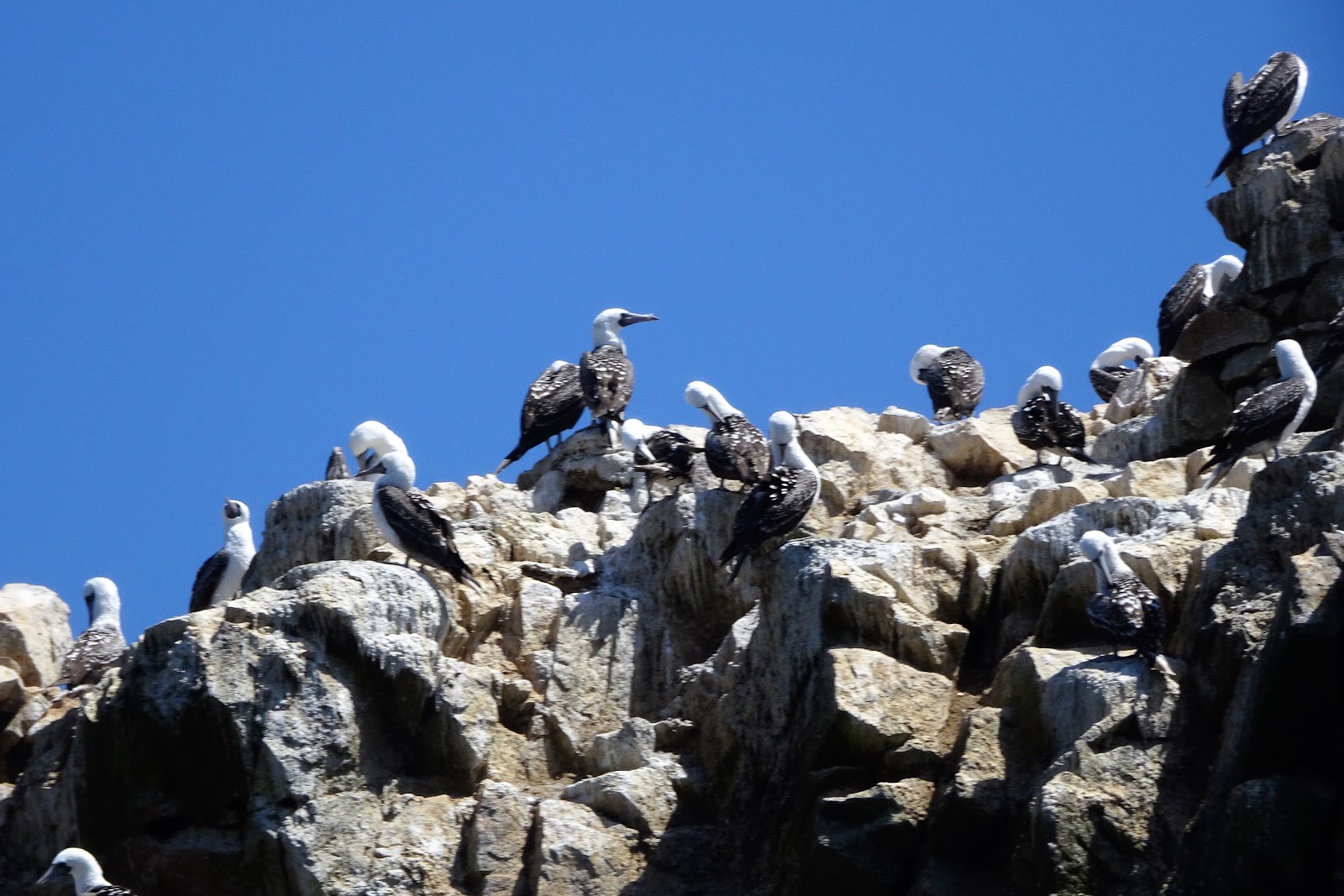
There are three adjacent Ballesta Islands that are collectively known as The Little Galapagos of Peru. We spent more than an hour circling the guano-covered islands, observing the wildlife. There were thousands of flamingos, pelicans, cormorants, Peruvian boobies, Humboldt penguins, and Inca terns. Our guide, said that there are 150 species of birds that are seen here. 


There were also more sea lions than you could possibly imagine. They seemed to like to crawl around and sleep on rocky spots or by the many caves and arches near the water line.


Most interesting was the “maternity beach” with hundreds of mothers and baby sea lions, with the babies crying out to their mothers plaintively.


We also enjoyed watching a mother sea lion teaching her baby to swim in the open water.


Our 30-minute drive, each way, to and from port, was through the Paracas National Reserve. There were many spectacular rolling hills, totally devoid of vegetation. There’s almost no rainfall here ever, except in an extremely unusual event. We were told that Paracas means “sandstorm” in the local language. In many ways, it looks like pictures of Mars that we’ve seen.


We were every glad to have taken the Ballestas Islands tour again, and it was a busy day snapping pictures.

Two of our world-cruise friends, Jim and Lois, took a different shore excursion today to see the famous Nazca Lines from a small plane. They reported that it was a great experience to see the ancient “geoglyphs” in the Nazca Desert from the air. The air was very clear and they were able to see everything perfectly. They said that the geoglyphs were bigger than expected, and they also enjoyed the museum which was co-located with the airport.

It’ll be a short cruise along the Peruvian coast tonight, as it isn’t far from our current location to our next in the busy port of Callao, Peru.

Jim & Ginny


Thursday, April 12, 2018

April 9, 2018 – Iquique, Chile

We’ve reached Iquique, in northern Chile, an area that was part of Peru until after the War of the Pacific. Iquique is an interesting location for many reasons, one of which is that it is located in one of the absolute driest places in the world, but it’s also a thriving tourist area for its beautiful Pacific Ocean beaches.

We went on an excellent shore excursion today called, “Ghost Town of Humberstone and Iquique Highlights.” We had a wonderful tour guide named Evelyn who kept us entertained and informed the whole time – she was a wealth of information.

First some important background information on local topography and climate. There are two tall mountain ranges that greatly affect climate here. The Chilean Coastal Range runs from north to south along the Pacific coast of Chile, parallel to the Andes Mountains. The Atacama Desert is located on the leeward side of the Coastal Range, which blocks moisture from the Pacific Ocean from reaching the desert from the west; while the Andes Mountains are so high that they block any clouds that could bring precipitation (from the Amazon Basin) from ever reaching the desert from the east. The cold Humboldt current and the semi-permanent South Pacific high-pressure ridge also are large factors in the dry climate.

The result is that Atacama is the driest hot desert on Earth. We understand that It rains about two millimeters (0.08 inches) a year in Iquique, but some weather stations in the Atacama have never received any rain.

The city of Iquique (population approximately 180,000) has the Pacific Ocean on one side of the city, and the coastal mountains on all other sides. The mountains are so tall that it looks like a very tall fortress wall surrounding the city. Upon leaving Iquique this morning, headed into the desert, we had to climb up and over a 2,500 ft. mountain almost immediately.


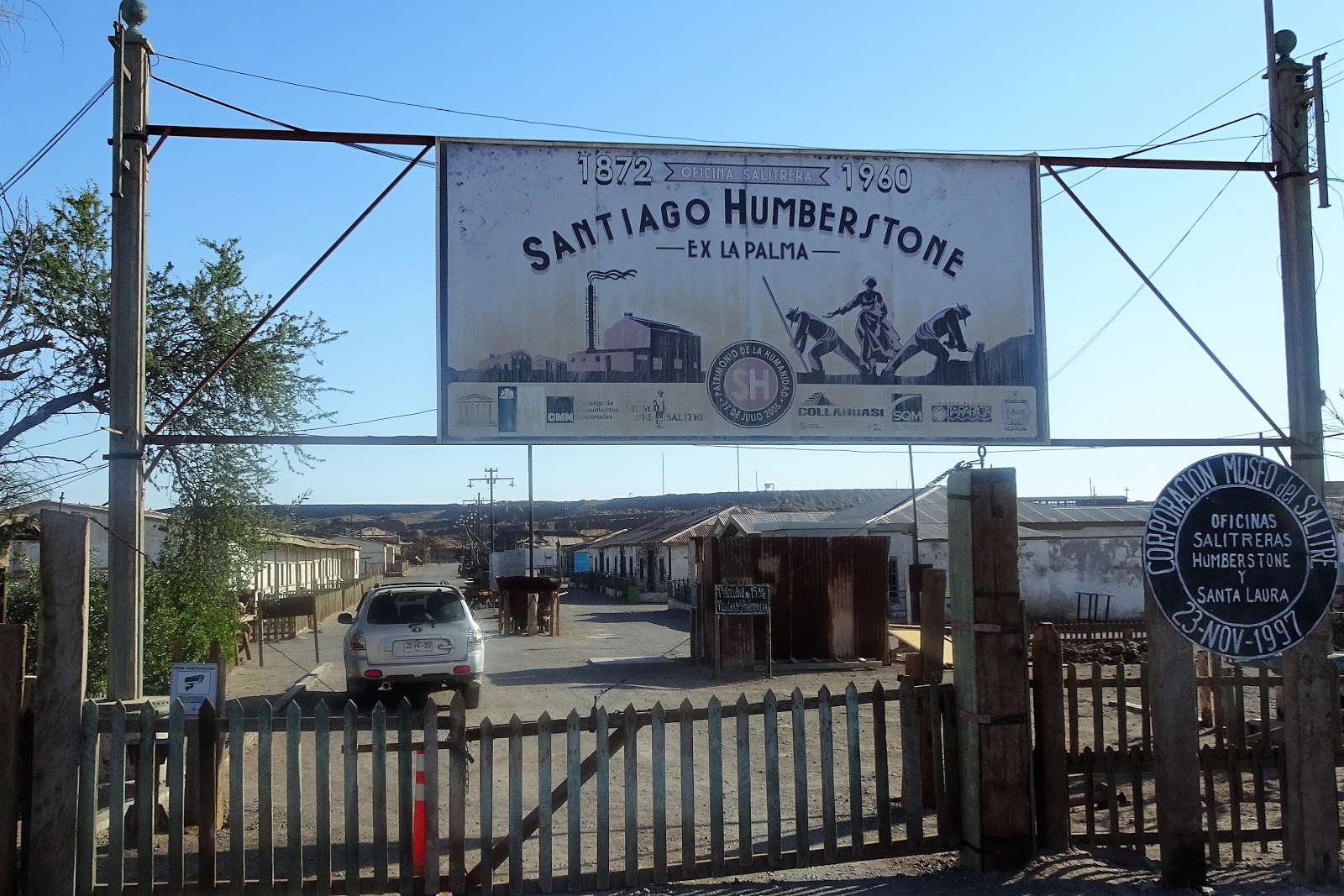
As we rode along for about an hour, Evelyn told us the history of Iquique and of the ghost town of Humberstone. The city and port of Iquique developed during the peak of the Sodium Nitrate (saltpeter) mining boom in the late 19th century. In 1872, James Humberstone, an Englishman, established a saltpeter mining company in the Atacama Desert about 30 miles east of Iquique. The company built a town named “La Palma” for industrial operations and as housing for the workers. Of course, at this time, national borders in this desert were unmarked and perhaps never established. Most of the mining companies that operated in the area were run by Chileans, backed by British investment.

Humberstone’s business grew quickly, and La Palma become a very busy town, with more than 3,000 people working in this hostile environment to mine and ship saltpeter, first via railroad to Iquique, and then for freighter transportation all over the world. At its peak, there were 3,700 people living here – workers, employees, and family members. For a while in the late 19th and early 20th centuries, almost all the saltpeter in the world came from the Atacama Desert. It was known as "white gold" and was in huge demand for use in fertilizers and explosives.

Eventually, there were disputes over taxation of profits from saltpeter mining, which directly led to the War of the Pacific (1879 – 1883). Chile won the war and annexed a large section of this nitrate-rich territory that Bolivia and Peru had claimed. We understand this is still a bone of contention even to this day, especially in Bolivia which lost its access to the Pacific Ocean.

During and after World War I, the British blockaded exports of saltpeter to Germany. That prompted the Germans to look for alternatives, and they invented synthetic substitutes that could be used to make fertilizer. Suddenly, no-one needed Chilean nitrate anymore. Production dropped dramatically, and employment fell. In 1959, the mines and plants at Humberstone shut down, and by 1960 the community was abandoned. The Chilean government renamed the town in honor of Humberstone, and it was declared to be a national monument. It was named as a UNESCO World Heritage Site in 2005.

We were amazed by what we saw in this ghost town. It looked like it had been a busy, lively community with a lot of activities for the residents. We thought there must be close to 100 buildings still standing, as if it was ready to fire up again at any minute. Evelyn gave us a guided tour of the town and told us that it was now being managed by a non-profit corporation of former children who had lived here with their parents. They want to preserve the town and are raising money through UNESCO and other sources to recreate what is part of their heritage.


No-one has lived or worked here for half a century. But in the dry desert air it apparently has been well-preserved. We visited the old company store where the workers bought their food and provisions, which has been set up as a nice museum. In the central town square, there is a tall town clock, a bandstand and large theater that must have provided residents with entertainment. Nearby are the remains of a hotel and restaurant, and even an old (empty) steel-lined swimming pool complete with diving board. We went in the four-room schoolhouse, still filled with wooden desks, as well as the old church building and the theater. 


After this most interesting visit, we returned to Iquique for a quick look at this city which appears to be booming again. Evelyn told us that this is partially due to the popular beach scene that has developed here, and the strong growth of copper mining, which is drawing businesses and workers to town. High-rise hotels and condos are springing up, especially along the Pacific coast. Our driver took us along the main avenue fronting the popular beach area of Cavancha, with big waves and a long, public walkway.


We stopped at the heart of town at Plaza Prat to do a little walking around. We spent a few minutes at a handicraft store and admired the 19th-century clock tower. One of the highlights of the day was a visit, including snacks and a Pisco Sour drink, at the “Centro Español” which was built in 1904 as a social and cultural center for the resident Spanish community. The interior of the building has tall ceilings, large paintings, and colorful tilework with a predominant Moorish flavor. Here we are with our Canadian world cruise friends Al & Karen.


In all, this was a great 5½-hour tour, which we enjoyed. We even learned some history lessons from this part of Chile. Now we’ll continue moving north in Peruvian waters and reach General San Martin, Peru on Wednesday, April 11th.

Jim & Ginny


Tuesday, April 10, 2018

April 7, 2018 – Coquimbo, Chile

We have begun segment five of our “South Pacific Reflections” 2018 World Cruise, which will go from Valparaiso (Chile) to Colon (Panama); this should take us a little less than two weeks. There was a massive change in the ship’s staff in Valparaiso, and we now have a new Captain (Master of the Vessel), Hotel Director, Cruise Director, both (male & female) lead vocalists, two new dancers, and many new waiters. Of course, almost all the “new” people are actually Crystal veterans who are just returning from vacation time off the ship.

A new segment also means many non-world-cruise passengers left the ship in Valparaiso, and new passengers boarded the ship. We have about 100 more total passengers now than we had on the Papeete to Valparaiso segment. We welcomed that, because now there will be two shows per night in the Galaxy Lounge instead of the one 9:15pm show we had for the whole past segment of the World Cruise. We prefer going to the “early” show (generally 7:30pm) and going to bed at a reasonable time of the night. Also, both lines are now open in the Market­place (Lido Deck) for breakfast and lunch, alleviating the crowding we experienced last segment up there for lunch when only one line was open each day.

Chile has a unique geography, on the western edge of South America. It’s a long, narrow country and is hemmed in on three sides -- the Pacific Ocean to the west and the Andes Mountains to the east. Chile stretches all the way southward to Cape Horn, the southernmost tip of the continent, and it even touches the Atlantic Ocean at the Strait of Magellan. It measures 2,653 miles between its northern and southern extremities, Chile has an average width of not much more than 100 miles, making it the world's longest and narrowest country. As a result, its 38-degree latitude span gives it an extremely varied climate and vegetation.

Our first port stop in Chile, at Valparaiso, was about in the middle of the country’s Pacific coastline (33°S). Overnight, we cruised northbound and reached Coquimbo (29.9°S) early this morning. This region lies at the narrowest part (or the “waist”) of Chile. The Andes Mountain Range runs closer to the sea here than elsewhere. 

We signed up for the shore excursion called, “La Serena and Elqui Valley.” We didn’t spend much time in the port town of Coquimbo – just enough to see that it’s a city of 200,000 people, built on steep hills and featuring several tall religious monuments, including the imposing “Cross of the Third Millennium” and a tall mosque. Our tour guide, Claudia, told us that the word Coquimbo means “calm waters.”


This was a busy 8-hour day of touring, and there was a lot to see. Of course, we started in Coquimbo which is a busy port city, especially for the export of copper, iron ore, and other minerals. China is their main trading partner.

We learned a lot about earthquakes. As we left Coquimbo and drove north along Coast Avenue, Claudia pointed out areas that were destroyed by the 2015 earthquake and tsunami. Some have not yet been repaired, including a fishing village. Chile is one of the earthquake centers of the world. In the past year, there were 5,000 earthquake tremors; and, just since we’ve been in Chile the past few days there have been five earthquakes, including one of magnitude 6.2.

Soon we arrived in La Serena, a popular tourist destination and capital of the Coquimbo region, with many condos, apartments, and hotels along the seafront beaches. We stopped for photos of the old lighthouse, although Claudia said that it doesn’t function as a lighthouse. But it is a symbol for the city. It was a good place to look at the ocean and take photos. Nobody was on the beach today, as it was a little cool this morning, and the summer season is winding down.


We turned to the east on Francisco de Aguirre Avenue, a busy attractive area accented by replicas of classical Greek statues in the center of the road. Claudia said that if we stayed on this road we would be in Argentina in three hours. Of course, you must cross the mountains first. They have many tourists from western Argentina coming here for time at the beach.

We soon entered the Elqui Valley, a narrow strip of land in the high desert. It was mountainous on both sides of the coach initially, and we saw a lot of Chandelier Cactus plants along the way. They grow to as high as four feet in height. 


As we rode further, approaching the town of Vicuña, the valley became remarkably fertile and Claudia told us that it was irrigated by the Elqui River, which brings water to the coast from the Andes Mountains. We also had glimpses of a pretty reservoir that was built in the desert by damming the river.


The Elqui Valley boasts one of the clearest skies in the world, making it ideal for astronomers and other stargazers. We were told that 40% of the world’s infrastructure of large telescopes are located in Chile. Of the top 10 telescopes in the world, five of them are located here. There are more scheduled for construction and, within 10 years, that 40% may grow to 70%. There was a shore excursion offered today to the Tololo Observatory, which we considered, but decided on the Pisco factory tour instead.

The area around Vicuña is mostly agricultural, including grapes, avocados, and citrus. They are especially well-known for their avocados. Of course, Chilean wine is world famous, but Muscat grapes in this region are grown for Pisco liquor, not for drinking wine.

Our walking tour of the CAPEL Pisco distillery lasted about 90 minutes. Pisco is a colorless (or amber color) grape brandy. CAPEL is the primary producer of Pisco in Chile. During processing, fermented grape juice is twice distilled in copper pot stills and aged at least 60 days in either French or American oak casks or stainless steel (we saw all three in use today). It is labeled by alcohol content – ranging between 30% up to close to 50%. Our guide led us to believe that higher alcohol level is indicative of a higher quality product with greater aroma and complexity.


Pisco is well-loved and popular in Chile, especially in drinks such as a Pisco Sour or mixed with fruit juice. Chileans consume most of the Pisco they produce. We tasted a very small amount of the final product and bought one bottle to bring home with us.

Next was a break for lunch in Vicuña, the largest town in the Elqui Valley (population 22,000). The bus dropped us off at the town square (Plaza de Gabriela Mistral) for a 15-minute stroll around the plaza on our own. The square is serenely quiet, with many lovely old trees and sculptures honoring Gabriela Mistral, who was born here and was awarded the Nobel prize in literature in 1945, the first Latin American author to do so. For lunch, we went to Halley’s Restaurant adjacent to the square and had an excellent meal before loading the bus for our return drive to La Serena.

In La Serena, we were scheduled to visit the Archeological Museum, but it was closed for refurbishing. Instead we visited the La Recova Market for handicraft shopping (reputed to have 143 stalls, but we didn’t count). It was a nice market, but we were pretty tired by then, so the 20 minutes allocated was enough for us to find the requisite refrigerator magnet.


Next stop, Iquique – our last port in Chile – on Monday (April 9th).

Jim & Ginny


Sunday, April 8, 2018

April 6, 2018 – Valparaiso, Chile

Not unexpectedly, seas were rough for the 400-mile transit from Robinson Crusoe Island to Valparaiso. Sea swells and waves were high, wind was between 45 - 50 knots (52 – 58 miles per hour), and there were relatively cool temperatures compared to our past several weeks in French Polynesia. This morning in Valparaiso, it was 59°F (15°C). Weather is still being influenced by the Humboldt Current bringing cold water from the Antarctic up along the west coast of South America.

We’re now at 33°S, 71.6°W, at the same longitude as Boston, Massachusetts, but our clocks are one time zone east of Boston (the same time as Nova Scotia and Bermuda).

Valparaíso is a city of 350,000 people on the Pacific coast of central Chile, approximately 70 miles west of the national capital in Santiago de Chile. Its history has been tied to the sea. Until the opening of the Panama Canal, Valparaíso was a near guaranteed stopover for all ships that had rounded Cape Horn traveling between the Atlantic and Pacific oceans. This was the golden age for Valparaíso, as immigrants, merchants, and banking institutions from many European countries set up shop here. The city grew to be a prosperous and cosmopolitan port, and there are still areas of the city known as the English, German, and Italian parts of town.

Alas, growth of the city and the infusion of money must have stopped with the opening of the Panama Canal. Today the city could best be described as “gritty,” with the meteoric growth of Santiago (70 miles away by road) and Valparaiso’s neighboring city of Viña del Mar passing it by. Much of the city itself is rundown, with lots of graffiti. However, Valparaiso can still brag of a very busy harbor (Chile’s principal seaport), a large Chilean Navy presence, seven universities, and the headquarters for the Chilean National Congress. In fact, the historic center of the city was designated a UNESCO World Heritage Site in 2003.

All that being said, we enjoyed our visit to Valparaiso (and Viña del Mar) today. Our travel agent (Preferred Travel of Naples), through their Signature Connection alliance, arranged for a private car and local guide to take us on an 8-hour guided tour, which was supposed to start at 7:00am. By the time local authorities cleared Symphony passengers to go ashore, and we took a mandatory shuttle bus ride through the large container port to the terminal, it was 7:30. Our local guide was waiting for us there. Sunrise wasn’t until after 8:00, so it was still a little dark the first part of the day.

Topographically, Valparaiso is quite unique. The city is spread over 45 hills (called cerros) that are mostly lined up north-to-south in a repeating “hill-valley-hill-valley” alignment. There are many narrow, winding, hilly streets, and almost no parking. This alignment leads to distinct neighborhoods known by the hill on which they’re located. There are many old (from the 1800s) funiculars, called Ascensores, for pedestrians to travel to the tops of the hills without the necessity of driving or walking long and steep routes. We traveled down one of these rickety funiculars (Ascensor Artillería) that was built in 1893, and we breathed a sigh of relief when we reached the bottom of the hill safely.


Interestingly, when the city was originally settled there were no flat lands at the base of these hills, but the port and business center were the result of massive landfills. This part of Chile was occupied by the Spanish who came down the Inca Trail (inland) and decided on setting up the capital where Santiago now sits. They then needed a port, so they filled in a narrow belt of land at the foot of the hills and founded Valparaiso in 1544. This lower, flat, coastal strip is now called, “El Plan.”

We started our tour at the southernmost hill and worked our way to the north. We think we visited 33 of the 45 hills and gained a lot of respect for the driver today, going steeply up and down these tall, narrow, curving hills all day. The first stop was at Punta Angeles where there is a large Navy base (just one of many of these bases) and a lighthouse. There was a nice view from here, even though the sun wasn’t fully up yet. We saw many views, especially of the large body of water in the bay and the port, from the tops of hills all day long in Valparaiso.


The remainder of the morning, we took in the ambiance of the many ethnic neighborhoods, while also doing a lot of walking up and down hills and connecting stairways. We admired the many brightly colored houses, beautiful seaside views, and the many old multi-story houses built along the sides of hills. 

On Artillery Hill (Cerro Artilleria) we admired the panoramic view and walked along the Mirador del Cerro Artilleria, where, later in the day there would be souvenir shops and small restaurants open. Unfortunately, not this early in the morning. 


We walked along several more of these pleasant promenades during the course of the morning; Paseo Atkinson was our personal favorite, although there was a full city-block of vacant homes along the prettiest part of the promenade.


On Cerro Bellavista, we spent about an hour at La Sebastiana -- the Valparaiso home of Chilean author Pablo Neruda who won the 1971 Nobel Prize for Literature. It is a narrow, 5-story home (lots of stars), with beautiful views and relics collected by Mr. Neruda.


We also did a little wandering around Plaza Sotomayor, in the center of Downtown Valparaiso, near the waterfront. Focus of the square is a monument to honor the Chilean sailors who died in the “Battle of Iquique” during the War of the Pacific (1879 – 1883). The monument shows a heroic statue of Captain Arturo Prat, who lost his life during the battle. As victor in this war, Chile acquired a large amount of territory from Peru and Bolivia. This seems to be a great source of pride to citizens of Chile. At the far end of the square is the palatial, blue-colored headquarters of the Chilean Navy.


Around noon, we headed north along the coast for about 20 minutes to Viña del Mar – a very different city. It is very neat and orderly in comparison to Valparaiso. The original developer’s name meant “Vineyard by the Sea,” but there are no longer any vineyards here. Today, this is a well-to-do city of over 400,000 people, with white-sand beaches, carefully designed parks and public spaces, wide avenues, modern architecture, tall resort hotels, condos, apartment buildings, and upscale shopping. Our guide told us that this beach resort city is often called Chile’s “Garden City.” Counting the nearby communities of Concón and Reñaca, this is considered to be Chile’s third largest metropolitan area. It is truly a big contrast to Valparaiso.

We stopped in Viña del Mar to look at the flower clock and drove past many (expensive looking) condo towers and stores, including shopping malls. We did go to one handicraft store where we bought a wall hanging consisting of copper and enameled bells. It was near the archaeological museum, with an Easter Island Moai in front of the building.


To take in the views, we rode along the coast a little past Viña del Mar and stopped for lunch at a nice restaurant specializing in seafood. We had the best table in the restaurant (surrounded by windows) reserved for us, and we watched the birds and seals frolicking in the water.

The Valparaiso area is rich in history and has an intriguing mix of cultures and architecture. We were glad we took the tour today.

Jim & Ginny