Pages

Saturday, March 3, 2018

March 3, 2018 – Auckland, New Zealand

The fairly short sea passage from Tauranga to Auckland on the North Island was unusually rough overnight, but as soon as Crystal Symphony entered Auckland’s protected harbor (Friday morning March 2nd), winds and waves died off. It was a comfortable, safe docking at Queens Wharf East, a great place to be docked, because it’s only a 5-minute walk to downtown. Unfortunately, rainy and gloomy weather continued through most of our first day in Auckland.

Auckland is New Zealand’s largest city, with one-third of all New Zealanders living here (1.5 million of New Zealand’s total population of 4.5 million). It’s a city of gleaming skyscrapers, but it’s definitely New Zealand through and through.

Our travel agent – Preferred Travel of Naples, Florida – and the Signature Collection, arranged for a (free) 4-hour private tour of Auckland with an Abercrombie & Kent tour guide and driver. We had chosen our first of two days in Auckland (March 2) for the private tour. Our guide, Samantha, and driver, Derrick, were both highly qualified and, just as importantly, flexible as to itinerary. We told them where we had visited during our last visit to Auckland, and that we didn’t want to do much walking around in the rain. They totally understood, and we spent much of our time driving around in their very comfortable car.

We began our visit at 9:30 by driving along Beach Road, passing several very nice-looking beachfront communities with parklands along the water, as well as biking, walking trails, and other family activities. We believe that two of these communities were named Mission Bay and St Heliers Bay. Our first stop was at Achilles Point, a scenic lookout platform, for views of Auckland's harbor and skyline, as well as some of the major islands nearby. Unfortunately, it was still misty enough that we could see something was out there, but there weren’t any great photo opportunities. However, the natural environment here was quite pleasant.

The site, Achilles Point, was named to commemorate the bravery of the crew and to honor the four New Zealand sailors from HMS Achilles (then operated by the Royal NZ Navy) who lost their lives in the South Atlantic at the Naval Battle off the River Plate during World War II (Dec.1939). The New Zealand Navy ship defeated a German battleship, the Admiral Graf Spee, even though they were greatly outgunned by the German vessel.

Next, we drove back into town on a fruitless pursuit of Golden Kiwi Jam, which Ginny wanted to purchase. We stopped at a nice Auckland specialty store named Farro Fresh Food – a store that displays and sells what they consider to be “the very best and finest of New Zealand food.” It was a beautiful store, but they didn’t have any Golden Kiwi Jam. Samantha claimed that she had never heard of such a thing, but it was worth a try.

We next drove through some old, established big-city types of neighborhoods that are still good places to live. Samantha used words like upscale boutiques, galleries and fine dining options for the Parnell neighborhood. For the Ponsonby neighborhood, she pointed out independent book-shops, trendy cafes, and bars specializing in craft beers.

This eventually led to what was probably the highlight of the tour for us -- Cornwall Park. This is a 425-acre oasis of greenery, gifted to the city by Sir John Logan Campbell in 1901. His wish was that the park be free for every New Zealander to enjoy, forever; the city has continued to honor his wish. Mr. Campbell was a successful businessman, revered by many as "the father of Auckland.”

There’s a lot to see in Cornwall Park – verdant green rolling fields, thousands of large native and exotic trees, playgrounds, even sheep, cows, chickens, and other animals wandering loose in the park. Derrick had to slow down a few times to allow sheep to cross the road. We found that amazing for parkland in a major world city – a breath of countryside in the heart of the city. Samantha told us that tens of thousands of annual plants and 10,000 bulbs are planted here every year. Included within the park area is One Tree Hill (Maungakiekie), a 597-foot tall volcanic peak. Samantha and Derrick told us that this is an important place for both Maori and other New Zealanders. We drove to the top and got out of the car to see the 360-degree views across the Auckland area, which was still somewhat obscured by clouds and fog. Auckland is built on a 7-mile wide isthmus, with Pacific Ocean on one side and Tasman Sea on the other.


On the top of One Tree Hill is a tall obelisk, serving as a memorial to the local Maori people, as requested by Sir John Logan Campbell (who left money in his estate for construction of the statue at this site). At the obelisk’s base, on one side is a bronze statue of a Maori warrior. On the other side is Mr. Campbell’s grave.

Samantha ended the tour with a visit to the top of Sky Tower – an iconic landmark on the Auckland skyline. It is 1,076 feet tall, making it the tallest free-standing structure in the Southern Hemisphere. This was a wonderful overall tour of Auckland. We saw a lot, and we learned a lot; but, of course, we just scratched the surface in a city of this size.


On board Symphony last evening, we greatly enjoyed watching an authentic, respectful presentation of traditional Maori music and dancing by the local “Haka the Legend” group. This included the Haka war chant made famous by the world champion New Zealand rugby team, and other traditional chants explained by an excellent narrator.

One interesting fact that we read: There are more Polynesian people living in Auckland than in all the Pacific Islands where they originated.


Saturday, March 3rd
Crystal Symphony remained docked overnight in Auckland. We woke up this morning feeling much happier, as the sky was blue and the sun was shining brightly. This is what it looked like from the bow of the ship this morning when Jim was walking around the Promenade Deck.


We decided to do some exploring on our own. Just outside the cruise ship terminal is Queen Street, the main street of Auckland. Our plan was to check out the ferry boat terminal just next door to us on Queen Street. We considered two options – the 12-minute ferry boat ride to Devonport Village – the historic site of the first Auckland settlement and home of the New Zealand Navy. Or, a 90-minute Harbor Cruise. We chose the Harbor Cruise and were happy that we did.

Pulling out of the ferry terminal, we had great views of Crystal Symphony and the downtown skyline. Also parked in the port were two strange looking ships that are now being used to transport new automobiles around the world for sale. We’ve seen them before, but they always surprise us. As we continued down the coast, we saw the pretty beach villages we had seen along the road yesterday (probably Mission Bay and St Heliers Bay).


We’ve seen Auckland referred to as “The City of Sails.” In fact, we read that at least one of every 10 Auckland residents owns a boat, and we saw lots of sailboats out in the water this Saturday morning. Later in the harbor cruise, we saw what was referred to as the largest marina in the Southern Hemisphere (3,000 berths).


As we passed under the very tall Harbor Bridge (spelled ‘Harbour’ in New Zealand), our captain slowed down the boat, and we experienced viewing something remarkable. He told us that sometimes people jump off this bridge on bungee cords, and he saw some activity that might mean that someone was going to try the jump. Within 2 – 3 minutes it happened, a body came hurtling off the bottom of the bridge at the end of a bungee rope. It turned out to be a young lady, and she was successful. She almost made it as far down as the water, but she didn’t get wet. Then she went flying back up and then down again. The boat then left to go back to the ferry terminal, so we don’t know how she got back up to the bridge level. You don’t see something like that every day!

After coming off the ferry boat, Ginny went to a nearby gift shop, and Jim walked down Queen Street to the National Maritime Museum (an outstanding attraction which we’ve visited in the past). Today, he was headed for the Volvo Racing Boats that we heard were down at the Viaduct Basin. It was easy to find, as there were thousands of other people headed there as well. The “Volvo Ocean Race” is a yacht race that goes around the world, held once every three years. The 2017-18 race started in Alicante, Spain on October 22, 2017. Leg 6 of the race left Hong Kong on February 7th and reached Auckland on February 27th. That leg lasted 20 days (6,500 miles in the open ocean), and the margin of victory at the finish was just two minutes between first and second place. There are actually only eight yachts in the race, but it’s apparently a big deal in the yachting world. The race is expected to finish in the Netherlands in late June 2018. We’re not knowledgeable about yachting, but it was interesting to see all the excitement and the crowds of people down there in the yacht basin.


Upon returning to the ship, we made a quick stop at the Bistro, a type of French Café on Deck Six.


We’re now beginning Segment 3 of our World Cruise 2018 -- leaving Auckland tonight, heading for Bay of Islands, which is even further north in New Zealand. 

We’ve seen Auckland rated as “one of the world’s most livable cities,” and we understand that. The combination of pleasant climate, casual lifestyle, beautiful harbors and bays, superb beaches, many nearby outdoor activities, and all the facilities and services of a booming urban center add up to something very appealing. We enjoyed the visit.

Jim & Ginny

Thursday, March 1, 2018

March 1, 2018 – Tauranga, New Zealand

As we head north along the east coast of New Zealand’s North Island, we arrived yesterday afternoon (Feb 28), a day early, in Tauranga. We had to skip Gisborne yesterday, due to unsafe sea conditions for tender boat operations.

The port of Tauranga is actually in the adjoining beach town of Mount Maunganui, about 10 miles away. Both are located on the Bay of Plenty, which received its name from Captain Cook, who sailed into this bay in 1769. Apparently, he found many friendly Maori settlements, and they were willing to give him a plentiful amount of supplies.

Looming close to the ship is the namesake for this community -- Mount Maunganui, a 750-foot tall dormant volcano. When we last visited here five years ago, Jim hiked part way up to a trail that goes around the mountain, and he had a great time. Yesterday there wasn’t time to do that; he left the ship at about 3:00 and walked around town for about an hour, conserving his energy for tomorrow’s trip to Hobbiton.


Crystal Symphony remained in port overnight, and we signed up for a shore excursion for today, March 1st. The tour, “Journey to Middle-Earth: The Hobbiton Movie Set & Farm” left the ship promptly at 8:30 a.m. Our driver/guide, named Murray, was a real comedian, and he kept everybody awake for the 1-hour drive to the site where the Lord of the Rings trilogy (1999) and the Hobbit movies (2011) were filmed.

Murray drove us first through the city of Tauranga -- population of 130,000 and growing (about 2% growth per year). The appeal of Tauranga, in Murray’s opinion, is the climate, and its location on the Bay of Plenty. He told us that many retirees are moving here, joining the large numbers of tourists who are drawn by its beaches and coastal lifestyle. He said that temperatures only rarely go below 3°C (37°F) in the winter or above 27°C (80°F) in summer. The sky was cloudy most of the day today, and we doubt that it ever got over 20°C (68°F).

The countryside we drove through was a beautiful shade of green the whole way. We saw lots of Silver Fern Trees, which is as much a symbol of New Zealand as the Kiwi Bird. Speaking of Kiwis, there are a lot of Kiwi fruit farms here. In fact, according to Murray, 80% of the Kiwi fruit exported from New Zealand comes from the region through which we were driving. Kiwi plants are grown in a similar manner to grapes – on vines. All the orchards we saw were surrounded by very tall hedges, which we assume serve as windbreaks. On the topic of population again, New Zealand has a total population of 4.5 million people. Of that number, 1.5 million live in the greater Auckland metropolitan area. The remainder of the country is sparsely populated.

The Hobbiton movie set was a privately-owned farm before the movies were filmed, and it still is a working farm, owned by a single family. As the story goes, film director Peter Jackson was searching for filming locations from the air in 1998 and selected this spot for Hobbiton. As there were no roads, buildings, or power lines, the location was ideal for the portrayal of Middle-Earth.


When we arrived at Hobbiton, a local guide, Christian, joined us on the coach to escort us to the starting point for our 1½-hour narrated walking tour through the hilly property. He told us that the set was rebuilt and slightly expanded for the Hobbit “prequel” in 2011. There are facades for 44 hobbit “holes” where the hobbit families lived under grass roofs and into the sides of hills (all have small, unfinished, earth-walled interiors). We were very impressed with how authentic the houses looked – they really looked like they had been lived in – as well as the beauty of the lush green natural surroundings, and the amount of work that must be involved to keep the area looking so wonderful – with so many flowering bushes, trees, and vegetable gardens. Christian told us that they have between 1,000 – 3,000 visitors here per day, depending on time of the year and the weather.

Jim must have taken photos of at least half of the 44 Hobbit homes, here are a few of them.


At the end of the walking tour, we enjoyed scones, muffins, and any one of four types of drinks, in the Green Dragon Inn, on property, before visiting the gift shop.

At the end of our drive back to Tauranga, Murray drove us through a nice upscale area in Tauranga (called Bethlehem) which seemed to be primarily for retirees. Then we drove through a nice Maori enclave neighborhood. He stopped the coach on the side of the road and asked one of the local ladies to talk about modern-day life for these indigenous citizens. Finally, back in the seaside community of Mount Maunganui, he drove by the beautiful beach area, which has been voted “Best Beach in New Zealand,” and is often graded as one of the top beaches in the world. Today there was a lot of rough surf.

This was a wonderful day, which we greatly enjoyed. We were very happy that we chose it for our full day in The Bay of Plenty.

Jim & Ginny

Tuesday, February 27, 2018

February 27, 2018 – Napier, New Zealand

The Captain docked Crystal Symphony into the cargo port in Napier this morning at 8:00 and, once again, we saw immediately that one of the major exports from Napier is timber. Docked very near us was a very large, specially-designed cargo ship being loaded with logs.


We last visited Napier five years ago and remember it as being a modern, attractive town with an interesting history. The town was almost totally leveled by a deadly 7.9 magnitude earthquake and a resulting fire back in 1931. When it was rebuilt after the disaster, a popular architectural style of the time – Art Deco – was used in many parts of town. Population of Napier is now 58,000 people.

The other good memory we had of Napier five years ago was a colorful Scottish marching band competition. We spent at least an hour watching this, and heard more bagpipes and Scottish drums than we could have imagined in one spot at one time. We had no such luck today, as there were no competitions scheduled.

We did a great 5-hour shore excursion today titled, “Clifton Sheep Station & Countryside Drive.” An excellent driver/guide named Ian drove us all around the fertile Heretaunga Plain, which lies west of Napier between Hawke’s Bay and the mountains.

Anyone familiar with the Hawke's Bay name would immediately think about the wine grown, produced and bottled here. Ian told us that this is the second largest wine-producing region in New Zealand, after only Marlborough. We rode by many vineyards along the way, including Beach House, Elephant Hill, Te Mata, Black Barn, Red Barrel, and Clearview. There were more, but these are the names we remember. We saw many fields of peaches and other stone fruits, kiwi (their biggest fruit export) and maize, as well as many sheep and cattle grazing. This is also the largest apple growing region in New Zealand.

After about 30 minutes, we arrived at the Clifton Sheep Station, a farm that has been run by the Gordon family for five generations. The farm was large – 2,500 acres – and they have about 4,000 head of Romney Sheep, as well as some cattle. Our host was Tommy Gordon, who started the visit with a demonstration of how his dogs round up a flock of sheep. He showed us three of his dogs – one short-hair border collie (the primary shepherd dog today), one Rottweiler mix (the huntaway), and one small fox terrier (which stayed by Tommy’s side today). All the dogs react to loud, shrill whistles from their owner. The shepherd dog didn’t bark, but gathered the sheep by staring at them, eye to eye. The huntaway dog specializes in barking at other animals to keep them away from the flock, but today he did bark a lot. The dogs did a perfect job finding the flock and herding them back to where we were watching.


Then we moved into a barn to watch a sheep shearing demonstration. Tommy held the large sheep against his body, so that she would relax. He wore special shoes, and the sheep was on his feet. He used an electric shearer that looked something like the electric hair clipper we see when we get a haircut in a barber shop. It looked like a lot of work to hold that sheep somewhat steady during the shearing. He went fairly slow for us, but we were told that an average shearer can do about 250 sheep per day, and the best can get up to 600 – 700 in a day. The sheep are sheared once every eight months, at different lengths, depending on the time of year. They pack the wool in bales that go to auction houses, and they’re paid depending on the winning bids.


After all that hard work while (watching) the shearing, we walked down the road to a rustic building called the Clifton Bay Café, along the waterfront, with views of Cape Kidnappers (so-named by Captain Cook). Here we were treated to fresh-baked scones with raspberry jam and cream, along with tea or coffee.

When leaving the farm, we traveled via Tuki Tuki Valley and up to the summit of Te Mata Peak at about 1,200 feet. It was a steep, narrow ride to the top, but Ian handled it perfectly and views of the valley below were superb. This must be a favorite area for local people, as there were kids here on a school outing, and there were many (challenging) walking trails.


Our final stop was in the countryside near the pretty township of Havelock North, where we stopped at a small roadside cluster of buildings called Birdside Gallery. We enjoyed sampling cups of homemade wild berry ice cream, which were delicious. We also looked through the gallery of art products and handicrafts, and visited another shop with confections.

We returned to Napier and admired the many attractions along the Marine Parade promenade ─ a long swath of green grass, public recreation sites, fountains, playgrounds, etc. ─ along the waters of Hawke's Bay between the highway and the water. We assume this (and the highway) were built on land reclaimed after the earthquake. These days it’s definitely a great place for strolling, relaxing, and other fun activities.

Napier still looks like a wonderful, fun little town. We wish we could have spent more time here, but our excursion today was also a great adventure.

We’ve been extra busy with all the New Zealand port stops coming one right after another and haven’t mentioned everything we’ve been doing onboard Crystal Symphony. The most notable event was a wonderful special function for full-world-cruise passengers only, back on Sunday, Feb 25th at Silk Restaurant on Deck 11. The event was called “Hooray for Hollywood” and included cocktails, dinner, and a show done by the World Cruise Entertainment Team. We greatly enjoyed the entire evening. Each course was tied to a movie and the dancers were dressed like famous actresses. There were songs sung between each course. The food was gourmet quality and unusual; for example, edible gold foil on our Indian dessert. Thanks go to Sarah Hayes, the World Cruise Hostess and Jonathon Hawkins, World Cruise Special Event Coordinator, who not only organized the event but also entertained us with their singing. Both are entertainers from the New York City area.


Tomorrow, we were scheduled for anchoring offshore at Gisborne, but sea conditions are predicted to not be favorable for safe operations of the tender boats to get us to shore. The Captain decided to not risk life or limb, so he will be skipping that port and will proceed to Tauranga.

Jim & Ginny

Monday, February 26, 2018

February 26, 2018 – Wellington, New Zealand

In this posting, we’ll describe two consecutive days on the opposite sides of the Cook Strait: first Nelson, at the northern end of New Zealand’s South Island, and then Wellington, on the southeast tip of the North Island.

Nelson, New Zealand ─ February 25, 2018
Sandwiched between our stops at two major New Zealand cities (Christchurch and Wellington), the visit at Nelson today was a welcome relief. This is a small town of approximately 51,000 residents (if the residents of the adjoining town of Richmond are included). Nelson has a reputation as the sunniest city in New Zealand, and it lived up to that today, with a very pleasant, sunny day. High temperature was 70°F (21°C).

English colonists first settled here in 1842. The city’s name honors British Admiral Horatio Nelson and his naval career in the Napoleonic Wars. 

We decided to explore Nelson on our own and took the shuttle bus into town from the industrial port where the ship was docked. The bus dropped us off, once again, at the i-SITE Tourist Information Center. Armed with the map that Crystal provides for each port stop, we decided to walk along Trafalgar Street all the way to the Anglican Cathedral, about ½ mile. This turned out to be a good decision, as this was the north-south oriented main street of town, with dozens of small stores, cafes, and art galleries to see. It was very crowded today with many local citizens meeting friends for lunch or just wandering around on such a beautiful day. At about the halfway point, we diverted over to Montgomery Square to check out the Nelson Sunday Market, which turned out to be something like a flea market.


Ginny remained at the market, while Jim returned to Trafalgar Street and walked up to the top of the hill on which the Cathedral sits. The cathedral has a 100-foot tall tower, and its construction was completed in 1965.

Wooden steps were first erected to the top of the Cathedral’s hill in 1858. They were replaced with granite steps in 1913 that are still in use today, and we understand they are a focal point for the city, serving as a stage for many purposes ─ such as celebrations, receptions, protests, a lunch spot.


We learned that the town of Nelson is known as an arts center, with hundreds of writers, artists, and other creative people living here. Of course, as in the rest of New Zealand, there is also much to enjoy here in the way of outdoor activities, to include hiking, fishing, kayaking, etc. There are three national parks nearby, as well as splendid sandy beaches, and the world-famous Marlborough wine region is easily reached from Nelson.

We returned to the i-SITE location to buy our obligatory souvenir refrigerator magnet and headed back to the port on the shuttle bus. Without exception, everyone we talked to on the ship about Nelson thought it was a wonderful town that they enjoyed visiting.

Symphony was docked in an unusually large container port for such a small town. Here is a panorama photo of the Nelson container port, taken from our stateroom balcony:


As we’ve seen in almost every port in New Zealand there are immense piles of timber stacked up here, ready for shipment to Asia – primarily China and Japan. Here’s what it looks like here in Nelson:


We’ve been told that New Zealanders are not depleting their hardwood forests. They have hundreds of thousands of acres of Monterey Pine tree farms in the country. These were originally imported from California, but they grow much faster in New Zealand – 30 years from planting to harvest (compared to 90 years in California). A new Monterey Pine tree is planted for each that is harvested.

Wellington, New Zealand ─ February 26, 2018
We crossed Cook Strait overnight, heading on an easterly course. This strait is notorious for choppy seas between New Zealand’s North and South Islands; and it was, in fact, a windy crossing with rough seas. The strait is only 20 miles wide, and it’s something like a wind tunnel at times, with wind funneling between the two mountainous land masses.

Wellington is the capital of New Zealand and is located almost exactly at the center of the country. Two other claims it can make -- Wellington is the southernmost capitol city in the world; and, because of its location near the Cook Strait, it is often called the windiest city in the world.

Crystal Symphony pulled in at the port at Wellington and docked on time at 8:00 a.m. The weather forecast for Wellington was for a 100% chance of rain today and, in fact, it was quite rainy, windy, and cold, this morning.

Our travel agent back home is a member of a consortium of agents called the Signature Collection. Signature arranged for a private half-day tour for us today in Wellington. Our car driver “John” and tour guide “John” were waiting for us as we disembarked the ship. Their 4‑hour private tour was great, although we and the guide modified the planned itinerary a lot, based on weather conditions.

During the course of our visit, we were driven through much of downtown, and we were able to get a sense of the city and the government buildings. This was quite a contrast to all the previous stops we’ve made in New Zealand. This is a modern and sophisticated city -- home to the government, embassies, first-class restaurants, and museums, along with steel and glass skyscrapers. Due to how the city is tucked in between water and the harbor to the south, and tall hills surrounding the city, there are many steep streets and cliff-hanging houses. Level land in Wellington has apparently become a rarity.

We mutually agreed to skip one of the major attractions that was on our itinerary – the Wellington Cable Car to the Kelburn Lookout and the top entrance of the Botanic Garden, where there are supposed to be great views. Today, in the rain, there would have been no views.

We didn’t take many photos today, because we didn’t want our camera to get wet.

Our first stop was at Old St. Paul’s Church, which our guide called “One of the finest examples of timber Gothic Revival architecture in the world.” It is certainly a beautiful wooden structure; built in 1866 and served as Wellington’s Anglican church until 1964, when the building itself was “retired” and church’s functions were transferred to the much larger St. Paul’s Cathedral nearby. It was saved from demolition and is now owned by the government and serves as a place of spiritual significance for many. We were told there are still public events taking place here ─ for example, weddings, funerals, or concerts.

We passed by the nearby “Beehive” which houses the Prime Minister’s office and other high-ranking officials. It’s called this because its shape reminds some people of a traditional woven beehive. It was built in stages during the 1970’s.


We were able to get out of the car and spend a little time visiting the “Old Government Building,” which was completed in 1876, and served as home for government civil service functions until 1998. John told us that it now houses the Victoria University's Law School. Portions of the building, on the ground floor, have been restored to its 1907 appearance as a historical site, open to the public. The building was constructed of wood, even the exterior which looked like stucco to us. It was an interesting site, and we’re glad we stopped to look it over.


We then drove to the old site of U.S. forces during World War II. We have read that at any one time between mid-1942 and mid-1944 there were between 15,000 and 45,000 American servicemen serving in New Zealand. John mentioned a visit to this site by Eleanor Roosevelt in 1943, which is still remembered by people in Wellington.

We spent more than an hour at the extraordinary Museum of New Zealand Te Papa Tongarewa. John arranged for a one hour guided group tour of this world-class museum, and it was a whirlwind review of wonderful exhibits, encompassing history, nature, and art. Of most interest were those on Maori culture and legends. We also found the exhibit of a giant squid, which normally lives a kilometer deep in the ocean, to be amazing. In retrospect, the museum was a great introduction to New Zealand. It would probably take us two to three days to see everything, but the one-hour review was very worthwhile.


At the end of our 4-hour tour, we had just enough time to ride up to Zealandia wildlife sanctuary, but not to go into the park. Instead, we, the driver, and the guide went to the second-floor coffee shop of the entrance building to order a special New Zealand coffee and look over a small corner of the park.

The plan was to spend as much time indoors, out of the rain, as possible. We accomplished that and thought we saw a lot of New Zealand’s capital city and culture of the Kiwi people, as they call themselves.

Jim & Ginny


Sunday, February 25, 2018

February 24, 2018 – Christchurch, New Zealand

We’ve been looking forward to seeing Christchurch for some time. Jim visited here nearly 50 years ago and thought then that it must be one of the most wonderful places in the world to live – very much an English city, with far better weather, and green gardens everywhere. It had always been called “The Garden City,” with fully ⅓ of its land area devoted to greenspace – parks, gardens, and reserves. But we were apprehensive about what we’d see, after reading so much about the terrible devastation that occurred during the two severe earthquakes they experienced here, five months apart, in September 2010 and February 2011.

Quick history -- colonizers from the Church of England arrived here in 1850 to found a model church settlement. We understand that they had plans to build a city around a cathedral and college, on the model of Christ Church in Oxford. Today, it is the South Island’s largest city with a population of 375,000 -- the third largest city in all of New Zealand, after Auckland and Wellington.

Location – Christchurch lies on the east coast, near the center of the South Island of New Zealand, east of the Canterbury Plain. Christchurch has the Southern Alps to the West, and the Pacific Ocean to the east. We docked this morning at Lyttlelton, the gateway port for Christchurch.


We decided to go on our own into Christchurch, giving us time to wander around, and be sure to see those things in which we were interested. We caught the free shuttle bus, which took about 30 minutes to ride from the port to the central city. The shuttle dropped us off at the i-SITE Visitor Information Center, adjacent to the old Arts Center on Worcester Boulevard.


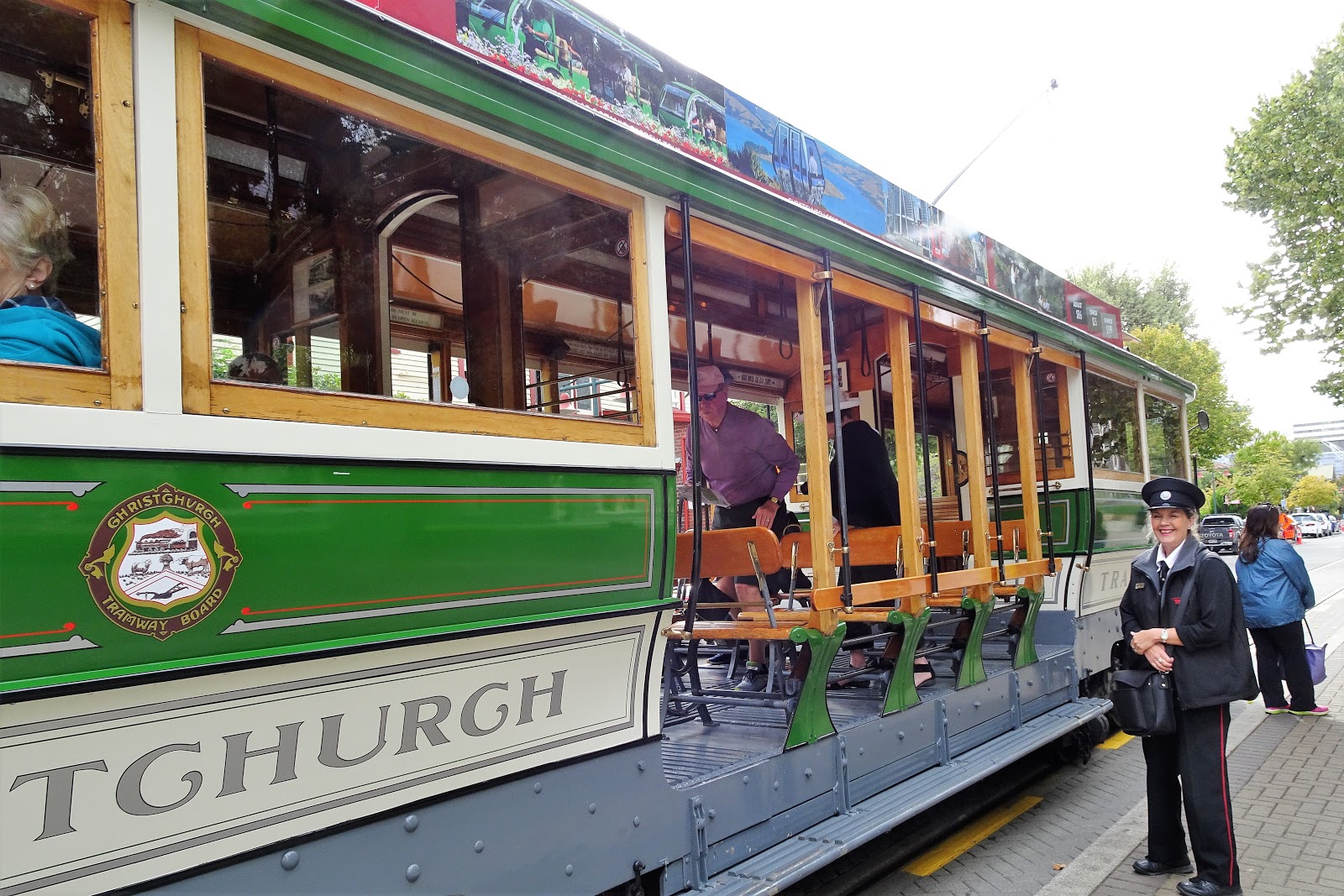
From there we purchased tickets to hop on an old vintage streetcar that runs on rails, named the Tram in Christchurch, for a 50-minute ride through the inner part of the city. We could use our ticket to hop on and hop off at any one of 17 stops. This was perfect for us – a great decision.


The tram driver gave an excellent commentary on the local landmarks and descriptions of the earthquake damage. They gave the impression that the city is bouncing back, but there is still a long way to go. It’s been seven years since the second (and most destructive) quake in February 2011, and many billions of dollars have been spent, but we still saw many vacant lots covered with rubble and buildings only half standing or just propped up. They are waiting for funding approval for repair or replacement. 


We were told that the 2011 earthquake brought down many buildings that had been damaged by the 2010 earthquake the previous September. Other buildings have been declared uninhabitable in the intervening years. More than half of the buildings in the central business district have since been demolished, including the city’s tallest building, a 20-story hotel. Of course, one of the biggest losses was the Christchurch Anglican Cathedral. Along the tram route, the driver pointed out the transitional place of worship, called the “Cardboard Cathedral.” 

After completing one loop of the tram, we hopped off at the closest stop for Canterbury Museum and the Botanic Garden. The museum has a notable collection of over 2 million items, including sections of the museum featuring Maori culture, the early colonizers, and natural history. Jim was especially interested in the section on Antarctic expeditions – Christchurch has been the gateway to Antarctica for over 100 years. After a lot of walking in the museum, we ate lunch at their café on the 4th floor.

The Botanic Garden is adjacent to the museum and is a large, magnificent green area in the city -- beautifully maintained and all-encompassing of flowers and trees from around the world, including a large section of native plantings. We were so happy to learn that at least this unique treasure of Christchurch survived the earthquakes nearly unscathed. In the interest of time (and our legs) we decided to take the 50-minute narrated Green Caterpillar tour of the gardens (an electrically-powered 20-person vehicle). The driver/guide was extraordinarily knowledgeable about what seemed like every plant and tree in the park. Cost for “seniors” was NZ$15.00 per person, and well worth it. The best parts of the gardens included the huge variety of plants, the immense rose garden, and the surprising number of Sequoia trees.


During the garden tour, we caught glimpses of the beautiful, meandering Avon River and people enjoying “punting” excursions on the river -- gliding down the river in a flat-bottomed boat with no keel, being pushed by a long pole wielded by a “punter” dressed in Edwardian fashion. This is definitely a highlight of Christchurch, but we settled for watching others enjoying the ride.


After our short visit, we can say that Christchurch is rebounding following the earthquakes, and there is a positive attitude, at least among the small sample of people we met. There seems to be a lot of creativity and innovation taking hold. We did see in many cases that old, historical properties are being replaced by modern, 21st century structures. Some of that is good, but well known international commercial brands seem to be filling spaces where local companies formerly existed. These are tough decisions, and we wish them well.

Tomorrow we continue to head north on New Zealand’s South Island to Nelson, all the way to 41 degrees south latitude. 

Jim & Ginny


Saturday, February 24, 2018

February 23, 2018 – Dunedin, New Zealand

We had a beautiful sail-in this morning. Dunedin lies 12 miles from the sea on the southeastern coast of the South Island of New Zealand, at the end of a deep and narrow fjord known as Otago Harbor. Cruise ships are unable to travel all the way inland to Dunedin, so we docked at a busy container port in the city of Port Chalmers, about midway to Dunedin. Docked next to us was an even larger cruise ship – Sea Princess. Also of interest in the port are all the piles of hardwood trees being shipped to China and Japan.


For our visit to Dunedin we booked a 6½ hour excursion with “Good Company Tours,” through our travel agent before leaving home in January. None of the Crystal shore excursions went to the two sites we wanted to visit—Larnach Castle and the Cadbury chocolate factory.

Upon disembarking the ship, we followed footprints painted on the road surface to a makeshift passenger terminal where we found Bill, the Good Company driver for our tour. There were about 25 people on the bus – most of whom were passengers from the Sea Princess. Unfortu­nately, many of them were coughing, hacking and sneezing. But, we pressed on, trying to avoid the worst coughers. Bill had been giving tours in Dunedin for 53 years; we think his bus may have been that old also. Anyway, he knew his way around town and had a lot of interesting and humorous stories for us.

Dunedin has a strong Scottish history, and they claim to have the largest concentration of Victorian and Edwardian architecture in New Zealand. But Dunedin isn’t all about history, as it is also home to the University of Otago, with about 23,000 students, according to Bill. During our drive through Dunedin, we stopped and walked a short distance on their very attractive campus.


We also stopped to look at what is claimed to be the steepest street in the world (Baldwin Street). Bill suggested that we not try to walk up the hill, as we might not live to talk about it. 


In Dunedin, we also stopped at the Octagon (an 8-sided plaza) which is the center of town, with a huge green lawn used for public events, concerts and parades. Also ringing the Octagon is a statue of Robert Burns, Dunedin’s Town Hall, the public library, an art gallery, St Paul's Anglican Cathedral, and various cafes and bars. 


Some quick history: Unlike the English settlement of the rest of New Zealand, Dunedin was founded by the Scottish Free Church (in 1848). Scottish settlers gave this community the name Dunedin, which we were told is the Scottish Gaelic name for Edinburgh. Dunedin's strong links to its Scottish heritage continue to this day; our driver, Bill, had a very strong Scottish brogue accent. In 1861, gold was discovered near Dunedin. Within four months, some 2,000 prospectors arrived by ship and crammed into this small community. Dunedin soon became New Zealand’s most prosperous city. Of course, the gold boom didn’t last forever, and growth slowed. Today, Dunedin has a population of 127,000 people (not counting students).

It was at least a 30-minute drive from Dunedin (mostly uphill) to Larnach Castle, New Zealand’s only “castle.” In our opinion, it isn’t really a castle, since it was built by a banker and politician, William Larnach, in 1871 as a very large mansion on a steep hill overlooking the Otago Peninsula. The castle has 43 rooms and an adjoining ballroom. Larnach spared no expense on this home, with materials and artists from around the world. The guided tour of the home lasted about one hour, and then we had time for lunch in the café which is located in the old ballroom.


The castle is now owned by a private family which has spent decades on its restoration. Entry fees help with maintenance and restoration costs. It is now one of the area’s premier visitor attractions. The castle’s tour guide, Robin, did an excellent job explaining the history of the castle and its many features.

Upon our return to Dunedin, Bill dropped off some people at a local brewery for a tour, along with others who just wanted to walk around town and catch the shuttle bus back to Port Chalmers on their own. We elected to tour the Cadbury’s Chocolate Factory for the Cadbury’s World Experience. The 1-hour tour explained the chocolate making process, liquid chocolate tasting, a chocolate waterfall in a tall silo (which Jim climbed halfway up in, to watch the process, while Ginny watched from below. They gave us samples of Cadbury products along the way. We may save them to give to our grandson Evan and granddaughter Erin (maybe). Or maybe we’ll be tempted to sample some of them along the way in the next two months.
Our last stop was to quickly visit the Dunedin Railway Station, built in what can only be called a Baroque style. Construction began in 1903, and the station was officially opened in 1906. During the city's most prosperous years this railway station was the country's busiest, handling as many as 100 trains each day. Now there are only a handful of local tourist trains in Dunedin every week. But it stands as a monument to Dunedin's Golden Days and is said to be New Zealand's most photographed building.


One interesting thing we heard from the Sea Princess passengers – they had tried to get into the same fjords we had visited earlier in the week (Milford, Doubtful, and Dusky), but they were unsuccessful. Their ship is a lot larger than ours (2,000 passengers compared to our 800). Maybe that was a factor. Anyway, they weren’t happy about it.

It was a long day, but we saw a lot. Now we’re looking forward to visiting Christchurch tomorrow.

Jim & Ginny